
Beyond Cookie Banners: The Future of Data Agreements Has Arrived
MyTerms (IEEE 7012) replaces opaque privacy policies and cookie banners with transparent, machine-readable data contracts between individuals and organisations.
DataPal helps organisations understand, evaluate and implement MyTerms — turning a looming compliance shift into a strategic advantage.
For organisations responsible for cookie banners, consent management and digital privacy, MyTerms represents a major turning point.
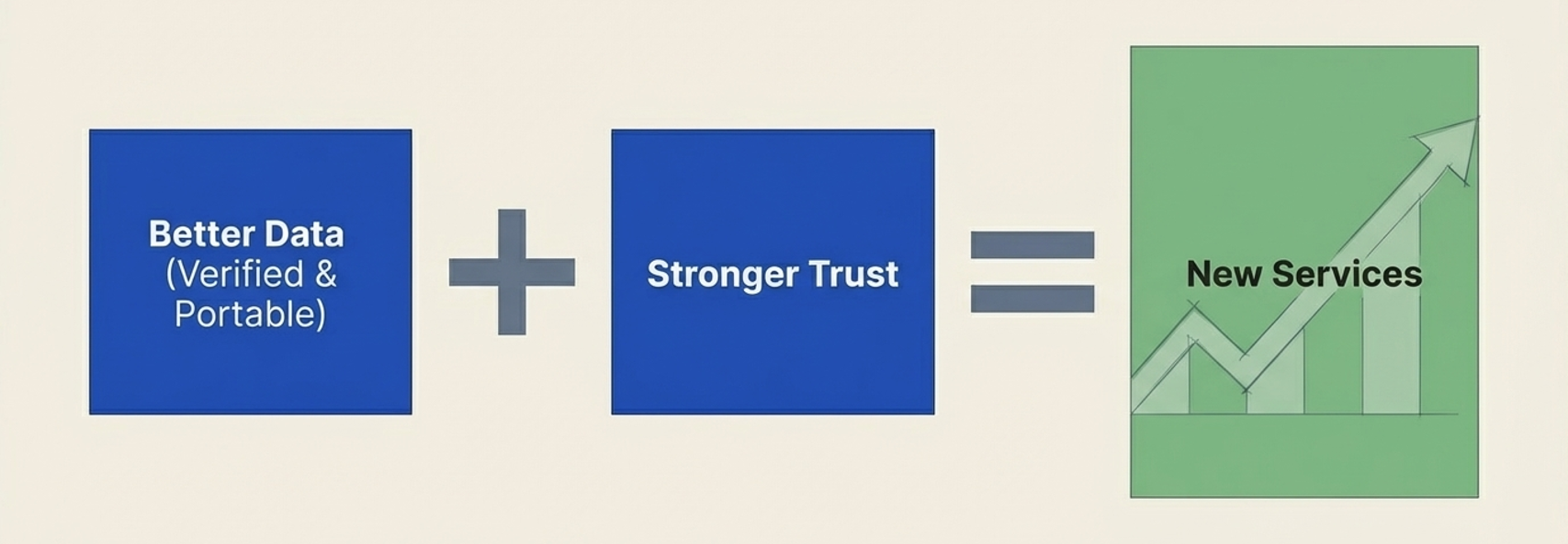
Handled well, it enables better data, stronger customer relationships and new AI-driven services.
Handled badly — or ignored — it risks disrupting existing data strategies and weakening trust with customers.
DataPal ensures you are ready.
MyTerms Enablement
Turning the End of Cookie Banners into a Strategic Advantage.
The way organisations collect and use personal data online is about to change fundamentally.
For more than a decade, websites have relied on cookie banners, consent notices and lengthy privacy policies to manage data relationships with users.
Everyone knows the truth:
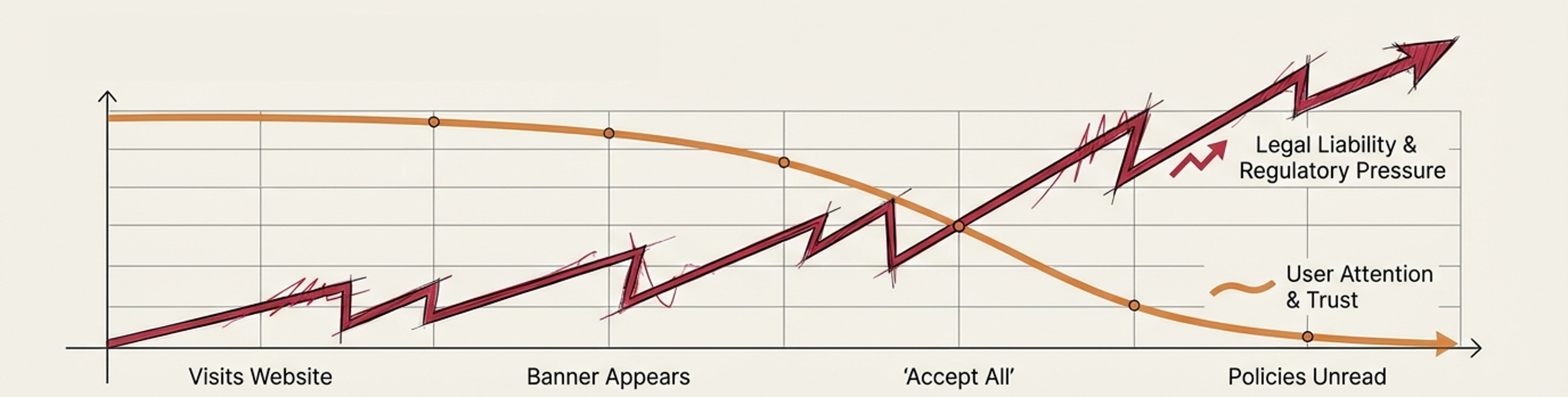
Users click “Accept All” without reading.
Organisations deploy increasingly complex consent tools to stay compliant.
Regulators know the system is broken.
Now a new global standard is emerging.
IEEE 7012 — known as MyTerms — introduces machine-readable, contract-based data agreements between individuals and organisations.
Instead of opaque privacy policies and manipulative cookie banners, MyTerms enables transparent, auditable, human-centric contracts for data sharing.
For organisations, this shift represents both opportunity and disruption.
Those who move early will build deeper customer trust, stronger first-party relationships and new data-driven services.
Those who delay risk losing control of the customer relationship to new trust-centric platforms and standards.
DataPal exists to help organisations navigate this transition.
Why MyTerms Matters
MyTerms introduces a radically different model for personal data exchange.
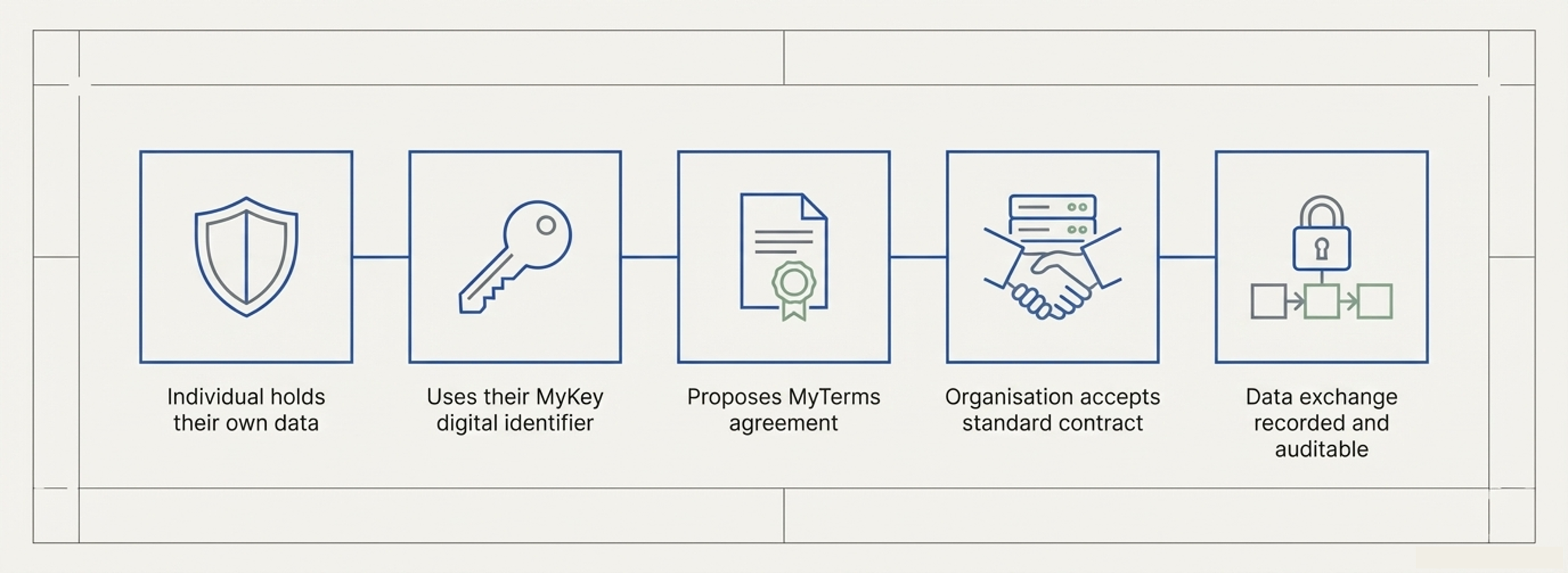
Instead of organisations defining terms through lengthy legal documents, individuals can propose standardised data agreements that organisations accept or negotiate.
These agreements are:
Machine readable
Cryptographically signed
Legally binding contracts
Recorded by both parties
They are based on core privacy principles that regulators have always intended but technology has struggled to implement:
Transparency
Data minimisation
Purpose limitation
In practice, this means moving from:
“Accept our privacy policy” to “Let’s agree the terms under which we share data.”
For organisations built around first-party relationships with customers, this opens the door to a new trust-driven digital economy.
The End of the Cookie Banner Era
Consent Management Platforms (CMPs), cookie banners and privacy notices were designed for a world where organisations controlled the terms of engagement.
MyTerms introduces a world where data relationships are negotiated and recorded as contracts.
This has significant implications for organisations responsible for:
Consent management
Privacy compliance
Data governance
Digital marketing
Website architecture
Customer data platforms
Put simply:
MyTerms has the potential to replace large parts of today’s cookie banner ecosystem.
For some organisations this will feel like a threat.
For others, it will be a once-in-a-generation opportunity to build trusted customer relationships and unlock better data.
Where DataPal Comes In
DataPal helps organisations understand what MyTerms means for them — technically, legally, commercially and culturally.
Our MyTerms Enablement service helps organisations move from curiosity to implementation.
We help you evaluate:
Technical implications
How MyTerms interacts with:
Consent Management Platforms
Customer Data Platforms
Identity systems
APIs and data flows
Website architecture
AI and agent-driven services
Compliance implications
How MyTerms fits within:
GDPR and global privacy frameworks
Data protection obligations
Contractual data sharing
Data portability initiatives
Regulatory expectations
Risk implications
What MyTerms means for:
Organisational data risk
Governance frameworks
Auditability
Contractual liability
Reputation and customer trust
Cultural implications
How adopting MyTerms changes:
Internal data governance
Marketing approaches
Customer relationship models
Cross-team collaboration
Bringing the Right Stakeholders Together
Implementing MyTerms is not purely a technical project.
It touches multiple teams across the organisation.
DataPal ensures the right stakeholders are involved from the start, including:
Privacy Lawyers
Data Protection Officers (DPOs)
Data and Analytics Leads
Information Security (InfoSec)
Website and Platform Teams
Technical Solution Architects
Digital Marketing Leaders
In short: Anyone in your organisation with a vested interest in a website’s cookie banner should be part of the conversation.
Why Organisations Work With DataPal
Implementing MyTerms is not the same as implementing another privacy tool.
It represents a new data relationship model between individuals and organisations.
Most systems integrators will approach MyTerms as a technical integration problem.
DataPal approaches it as a strategic transformation opportunity.
Our expertise sits at the intersection of:
Data strategy
Privacy technology
Digital identity
AI-driven services
Customer relationship architecture
This allows us to help organisations design implementations that deliver real business value, not just compliance.
DataPal’s Unique Perspective
DataPal is not just advising on MyTerms.
We are building the technologies that will enable individuals to operate within the MyTerms ecosystem.
DataPal provides individuals with a personal data control dashboard where they can:
Manage their digital identity
Curate their personal data
Share information securely
Engage with organisations under MyTerms agreements
Deploy AI agents to act on their behalf
Within DataPal, personal data is organised around five key components:
Core Details
Data About Me
Things I Have (products and services)
Things I Want (future products and services)
Jobs to Be Done (tasks executed by permissioned AI agents)
This architecture creates the foundation for agent-driven digital services and trusted data relationships.
It also means DataPal understands how MyTerms will work in practice — not just in theory.
From Surveillance Economy to Trust Economy
The current digital ecosystem was built around data extraction.
Organisations gather as much information as possible and then attempt to justify its use through complex privacy policies.
This model is increasingly:
Distrusted by users
Constrained by regulators
Inefficient for organisations
MyTerms enables a different model.
One where:
Individuals control how their data is shared
Organisations receive higher-quality data
Trust becomes a competitive advantage
This shift will enable a new category of agentic commerce, where individuals use software agents to manage data relationships and transact with organisations under agreed terms.
Forward-thinking organisations will see this not as a constraint, but as an entirely new digital channel.
A Strategic Moment for Digital Leaders
The publication of IEEE 7012 marks the beginning of a major shift in how personal data is governed online.
For organisations with strong customer relationships, this is an opportunity to:
Build trust at scale
Improve data quality
Simplify compliance
Unlock new AI-driven services
Differentiate in a privacy-first world
But like all platform shifts, the advantages will go to those who move early and learn fast.
Start Your MyTerms Journey with DataPal
DataPal helps organisations understand, evaluate and implement MyTerms in a structured, commercially grounded way.
Our MyTerms Enablement programme helps you:
Understand the impact of MyTerms on your organisation
Identify strategic opportunities
Evaluate technical architecture
Align stakeholders across legal, technical and business teams
Design an implementation roadmap
Whether MyTerms becomes a competitive advantage or a competitive threat will depend on how organisations respond today.
DataPal helps ensure you are on the right side of that transition.
Empowering Individuals, Not Platforms
DataPal exists to build a more trustworthy digital ecosystem.
One where individuals have genuine agency over their data and organisations build relationships based on transparency and mutual value.
MyTerms is a key part of that future.
And the time to start preparing is now.

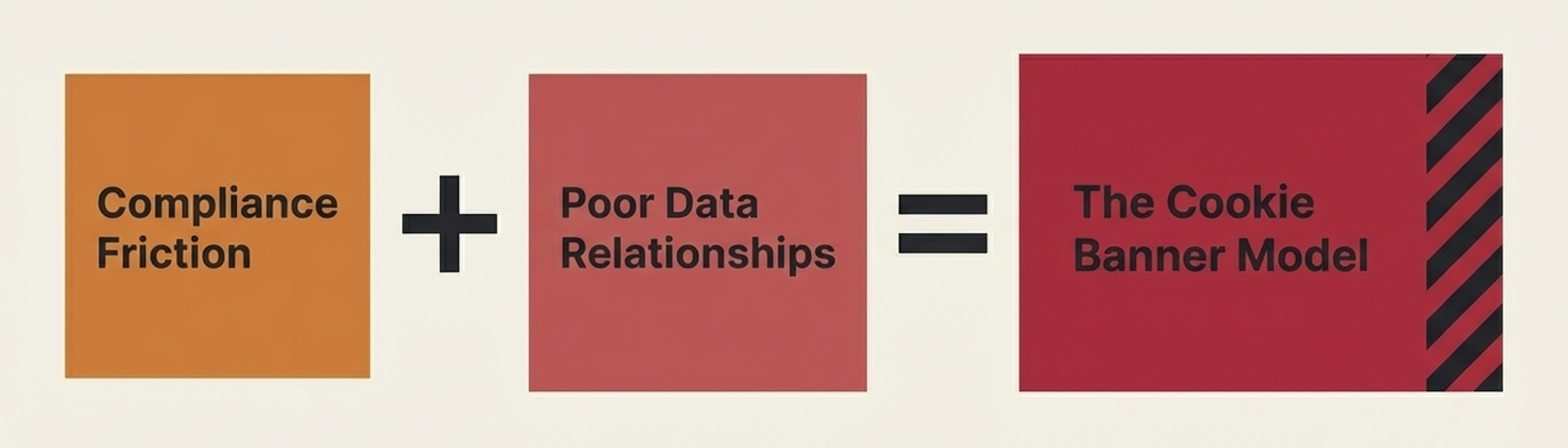
An ecosystem defined by defensive compliance rather than user value
The MyTerms Model: Unlocking net-new value through seamless digital relationships