

Client–Server Is Ending. Server–Server Is Next.
For nearly forty years, the dominant architecture of the digital world has been client–server.
It powered the web.
It enabled ecommerce.
It scaled cloud computing.
And it quietly shaped the power structure of the internet.
At roughly the same time this architecture matured, we adopted another construct to protect individuals online: consent. Consent became the ceremony through which personal data could flow from individuals to organisations. Click a box. Accept the terms. Proceed.
Both systems still function.
Both are also fraying at the edges.
And neither was designed for the world we now live in.
The Hidden Assumption in Client–Server
In a client–server model, the organisation runs the server. The individual connects via a client — usually a browser or mobile app.
Technically, the server is powerful. It stores data. It runs logic. It enforces rules. It maintains audit trails.
The client does what it is allowed to do.
That asymmetry isn’t accidental. It is structural.
The server defines:
The rules of engagement
The data it collects
The retention policy
The enforcement mechanisms
The economic model
The individual can agree — or walk away.
But “walk away” is not a realistic choice when nearly every digital service operates on the same model.
Infrastructure shapes incentives.
Incentives shape behaviour.
Client–server encodes asymmetry.
For document retrieval in the 1990s, that was fine.
For identity, finance, health, AI agents, reputation and persistent digital relationships — it is not.
Consent Was Designed for Simpler Times
Consent emerged as a legal mechanism to regulate data sharing between individuals and organisations.
It assumes:
Clear purpose
Defined scope
Equality of bargaining power
Discrete transactions
None of those assumptions hold in modern digital life.
Today, data sharing is continuous.
Relationships are persistent.
Tracking is invisible.
And AI systems amplify the consequences of data misuse.
Consent checkboxes and cookie banners are now ritual theatre.
Europe alone spends an estimated 334 million hours per year clicking through cookie notices. That is not privacy. That is friction disguised as protection.
The deeper problem is not that people don’t read privacy policies.
It is that consent cannot correct structural power imbalance.
When one party designs the system, drafts the terms, controls enforcement and defines economic incentives, consent becomes procedural compliance — not meaningful choice.
We are trying to regulate a networked, AI-mediated ecosystem with a transactional, paper-era construct.
It cannot scale.
The AI Inflection Point
This architectural tension becomes critical in the age of AI.
AI agents increasingly:
Make recommendations
Evaluate eligibility
Detect fraud
Assess risk
Personalise pricing
Negotiate outcomes
AI systems require persistent context.
But under client–server, context lives inside organisational silos.
AI cannot reliably operate on behalf of individuals if the individual does not control persistent, portable, verifiable context.
In an AI-native world, whoever controls the server controls:
The narrative
The identity
The economic outcome
Without structural change, AI amplifies asymmetry.
The Obvious Upgrade
The solution is not more banners.
It is architectural.
Move from client–server to server–server.
In this model:
Organisations operate servers.
Individuals also operate servers.
Intelligent endpoints communicate directly.
Terms are programmable.
Auditability exists on both sides.
Data sharing becomes negotiated, not imposed.
This is not decentralisation chaos.
It is standards-based, interoperable, programmable infrastructure.
It upgrades the network from clever servers talking to limited clients — to clever servers talking to other clever servers.
The power dynamic changes because capability changes.
The Hardware Already Exists
For most people, the “personal server” is already in their pocket.
Modern smartphones:
Outperform enterprise servers from a decade ago
Contain secure enclaves
Use biometric authentication
Maintain persistent connectivity
Store cryptographic keys
Operate continuously
The hardware foundation exists at global scale.
The missing layer is coordinated software infrastructure: identity, programmable terms, secure data orchestration, and interoperable protocols.
Architecture Determines Accountability
Client–server embeds organisational primacy.
Server–server enables reciprocity.
When individuals possess programmable infrastructure, they can:
Propose their own data sharing terms
Share context selectively
Revoke access programmatically
Maintain audit logs
Prove attributes without exposing raw data
Delegate access to trusted agents
Consent becomes code.
Terms become executable.
Relationships become symmetrical.
This is not anti-organisation.
In fact, organisations that are trust-oriented — especially in regulated sectors such as finance, health, and public services — benefit enormously.
They gain:
Cleaner, permissioned data
Clear provenance
Reduced compliance ambiguity
Stronger security posture
More resilient digital relationships
Surveillance-based business models may resist.
Trust-based business models will thrive.
Why Now?
This shift is not speculative.
Several conditions have aligned:
Smartphones are secure compute platforms.
Secure identity standards are maturing.
Regulatory frameworks increasingly demand accountability and portability.
AI systems require higher quality context.
Public trust in current consent models is declining.
Technically feasible.
Commercially viable.
Regulatorily aligned.
The question is no longer whether this upgrade can happen.
It is whether we choose to make it happen deliberately — or wait until trust collapses and regulation forces it.
Beyond Silos: A Network of Peers
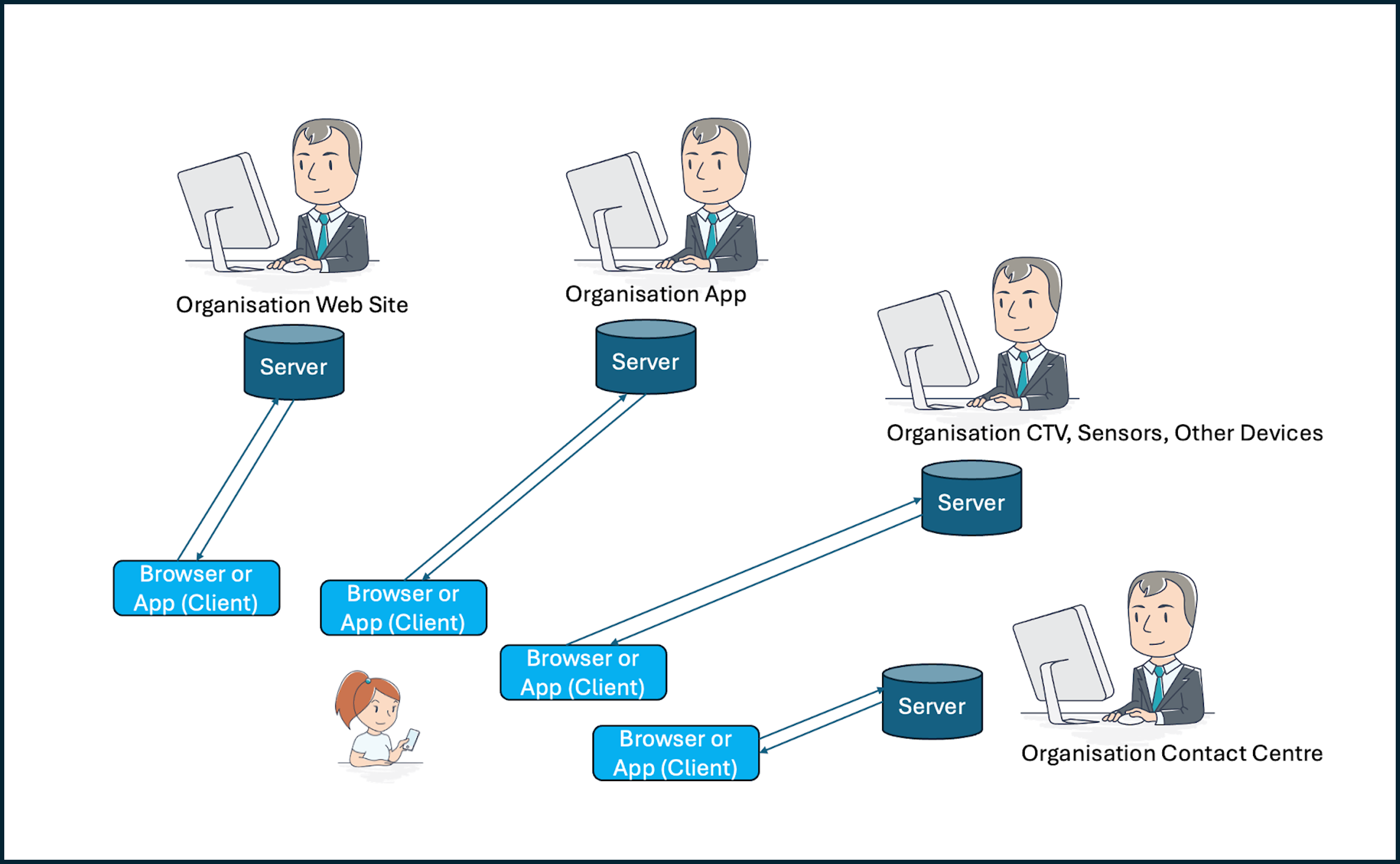
Client–server produces silos.
Each organisation accumulates its own partial, fragmented view of the individual.
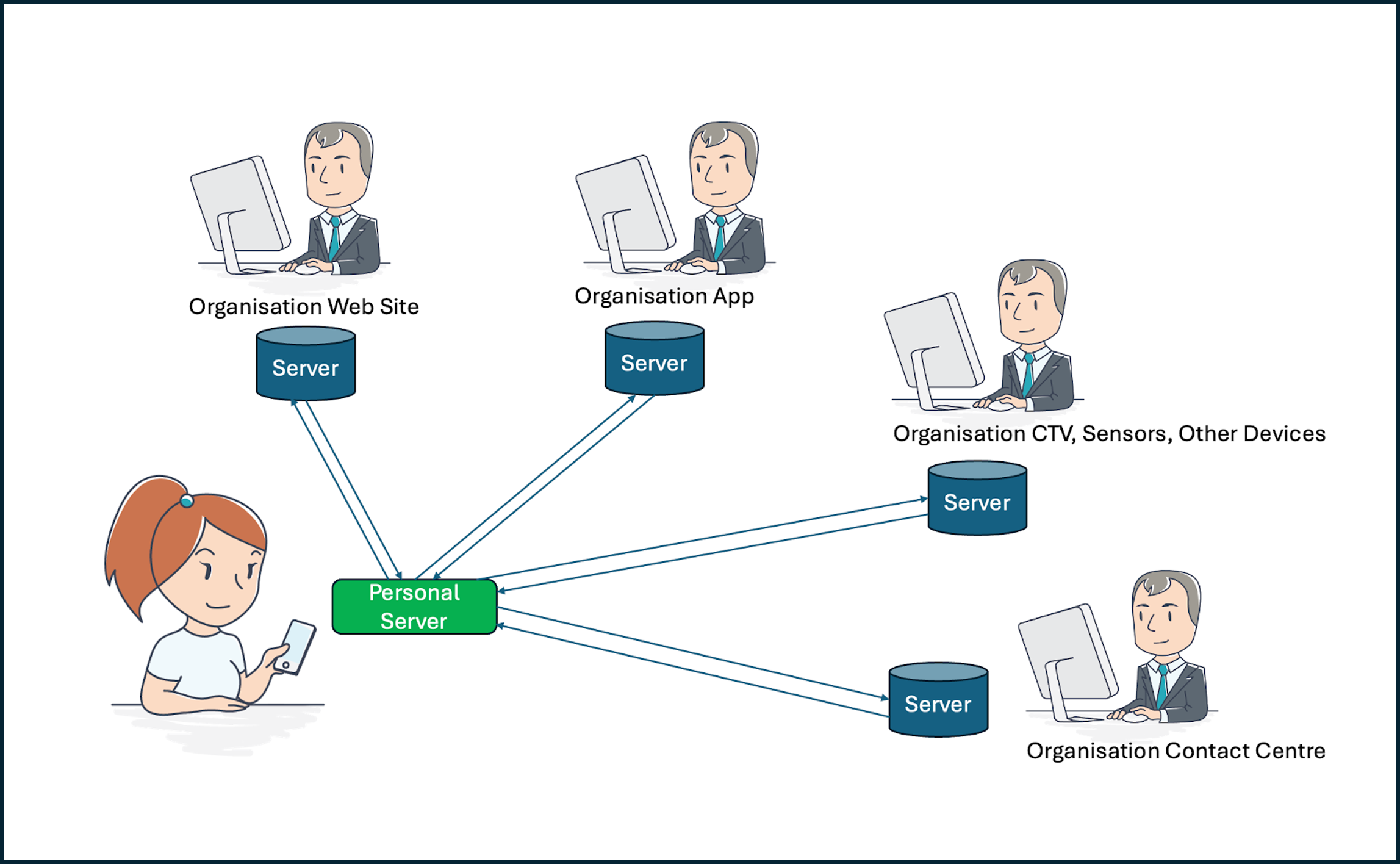
Server–server produces networks.
Individuals hold their own persistent context and selectively engage.
Instead of:
Organisation A → Client
Organisation B → Client
Organisation C → Client
We move to:
Organisation A ↔ Individual Server
Organisation B ↔ Individual Server
Organisation C ↔ Individual Server
And, where appropriate, server-to-server interoperability between organisations occurs under terms defined and enforced by both sides.
This unlocks entirely new models:
AI agents operating with trusted personal context
Personal financial and health dashboards under user control
Intent-based advertising (pull, not push)
Secure attribute verification without data duplication
Programmable, revocable data access
Cross-sector relationship management
The innovation surface expands — it does not shrink.
FROM: When we as individuals don’t have strong relationship management tools of our own, we are always disadvantaged and need to deal with every organisation separately.
TO: When we as individuals do have strong relationship management tools of our own, we are independent actors. We can bring our own data, tools and terms – to the benefit of all.
The Economic Opportunity
The current consent regime wastes time and erodes trust.
Server–server infrastructure reduces friction while increasing accountability.
That combination matters.
Trust is now a competitive differentiator.
Organisations spend vast resources on:
Compliance theatre
Data breach remediation
Customer acquisition
Trust rebuilding
Architecture that structurally aligns incentives reduces all of the above.
It creates a foundation for durable digital relationships.
The Cultural Shift
This transition requires a mindset shift.
For decades, digital architecture has been organisation-centric.
Server–server recognises that individuals are persistent actors in the network — not temporary visitors to someone else’s system.
It reframes people not as endpoints of data extraction, but as first-class nodes in a programmable ecosystem.
That shift is subtle.
It is also profound.
A Decade From Now
Within ten years, today’s model of clicking “I agree” on opaque terms drafted by one side may look as archaic as fax-based contracts.
Not because the web failed.
But because it evolved.
Client–server was a brilliant foundation.
It built the digital economy.
But we now use the internet for far more than retrieving documents or sending messages.
We use it to mediate identity, capital, health, knowledge, and increasingly — machine intelligence.
That requires symmetry.
It requires accountability on both sides.
It requires infrastructure that reflects the complexity of modern digital life.
The internet upgraded from dial-up to fibre.
It is time to upgrade its power model as well.
Client–server built the silos.
Server–server will build the network.
And in doing so, it may finally make digital relationships worthy of the trust we place in them.