

My Personal Agents and how they will radically improve CRM and change Customer Experience (CX)
So, continuing the drill down into the My Protocol stack, we have now established the protective shield (MyTerms) inside which an individual can safely operate online. This allows people to operate in a trustworthy space; as opposed to the hostile territory they are inevitably in at present.
An important new capability can then emerge and operate in that trusted space - My Personal Agents.
My Personal Agents are a combination of identifiers, data, AI, expert systems and workflow that help people get things done. The critical innovation, and why these agents are so important, is that they allow people to get things done without them having to be there to ‘do the clicks’. So, we are no longer constrained by that old phrase ‘there are not enough hours in the day’. And we can begin to get on top of that giant backlog of things that we all know we should do; but usually don’t get time to. Or do much earlier and more effectively than those things we always leave to the last minute.
There is a key distinction to be aware of up front. Personal Agents are contracted to work for you, the individual. This is not the same as the many organisation-centric agents that will appear on supplier apps and web sites; often surfacing at the moment as chatbots. The relationship between a personal agent and their related person will always be a fiduciary one. That is to say, the same as you’d have with your doctor, accountant, lawyer or other professions that work with that duty of loyalty and care to the individual first. At this stage it is probably also worth pointing out that this concept is not a new one. HMRC (UK Tax Office) has enabled people to appoint agents, and indeed software as their agents for many years - in the form of accountants and certain types of tax or expense management software.
So Personal Agents work on behalf of people to get things done. This plays very nicely into the long understood customer management theory of ‘Jobs to be Done’ that shapes how many organisations present their products and services. Simplistically this theory is that customers are not buying for the sake of buying; they are doing so because the purchase wholly or partially enables an outcome. Jobs to be Done can be functional, or emotional. Ultimately there are thousands of jobs to be done that can be identified across all aspects of life. This Harvard Business Review article walks through four of them as detailed examples.
The reason it is so helpful to look back from outcomes sought, and their related jobs to be done, is that when building Personal Agents we can understand, build and then optimise for the outcome sought; not just for its component parts.
From here on then, this is a story about identifiers, processes, verbs and nouns. Agents programmatically apply verbs to nouns within a defined context. For example:
I (identifier and context) want to buy (verb) a widget (noun)
I (identifier and context) want to renew (verb) my passport (noun)
We (identifiers and context) want to compare (verb) our service contract(s) (noun) with other options
I (identifier and context) want you to fix my broken service (noun)
There are thousands of these jobs to be done that can and will be supported via agents following these patterns and similar. Each will have detailed process steps, essential and optional data; guardrails to ensure they do only what they should. And data provenance should be tracked so that all parties can see and learn from what is being done. And yes, agents will work with other agents, likely with an overarching ‘conductor’ agent that is about overall orchestration an communicating with ‘the human in the loop’.
What those agents do, and how they do it, should be transparent. That, and the ‘no lock-in’ mind-set is inherited from the MyTerms protective layer. In that world, the best agent wins (as seen from the perspective of delivering best outcomes for the individual for whom the agent is working).
What will this all mean for how things work at present - you may well ask? Personal Agents, in my view, will be very disruptive of the current modus operandi…, in a good way.
The visual below uses the ‘infinite loop’ concept that dates back to the earliest days of CRM. It is always, for me anyway, great at explaining what the customer is aiming/ hoping to achieve at each step in their buying/ owning journey. I’ve picked out 4 steps in the journey that I believe Personal Agents will have a major impact (for the better of both parties):
How people express and share their requirements and intentions (will be vastly improved using LLM augmentation and made available under MyTerms).
How people share and verify their identity, and prove things (e.g. age, employment status, earnings and many more) becomes vastly better when Personal Agents are in the mix.
Managing privacy and data sharing becomes vastly better when Personal Agents and MyTerms are in play.
Customer service cases become jointly owned opportunities to fix and improve things when both parties have the Agents that have access to relevant knowledge and processes they can engage.
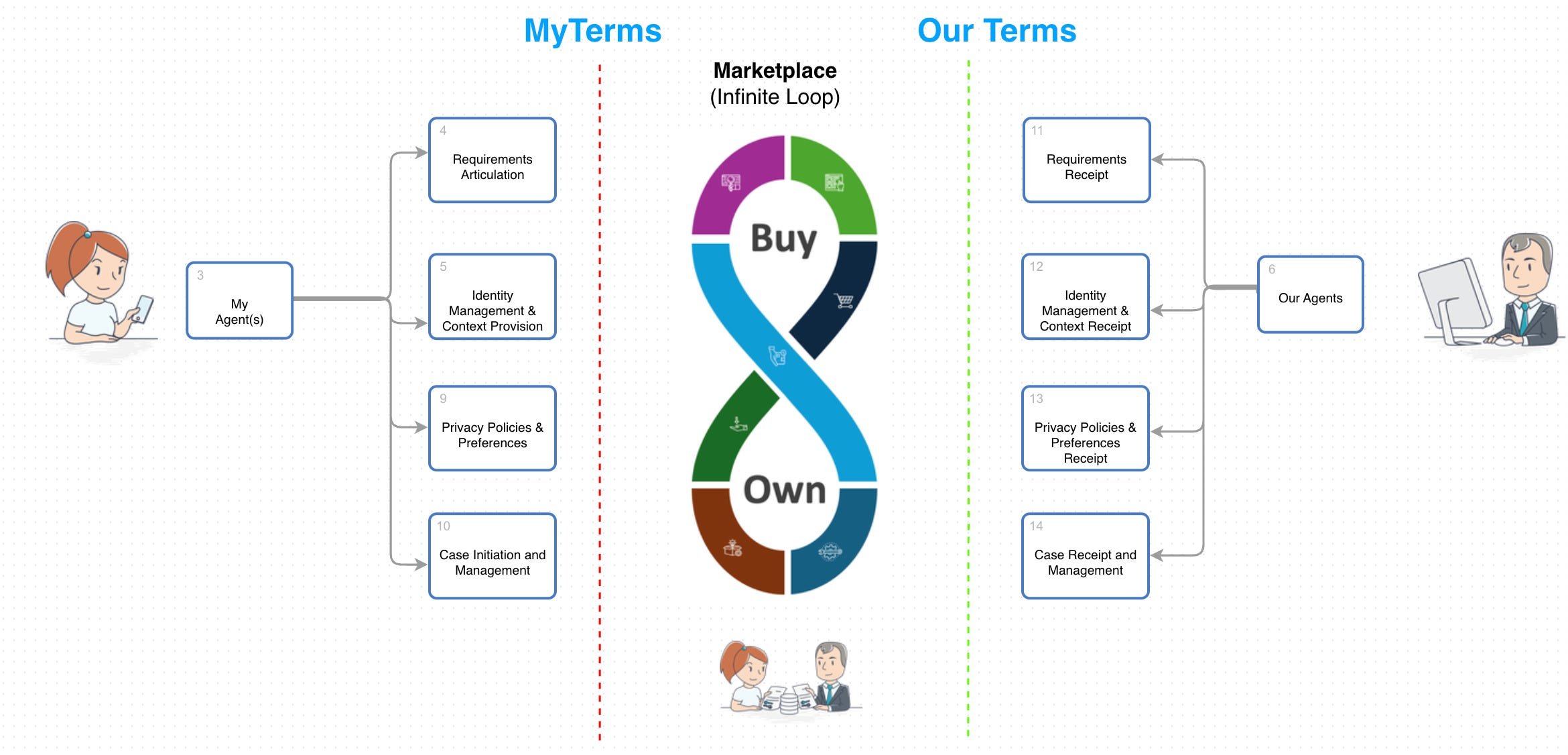
That’s only four areas where I think Personal Agents will radically help both individuals and the organisations they deal with. I think there are at least forty more around that Infinite Loop where I think benefits will emerge. So over time the impact of Personal Agents will be massive.
What can and should organisations do to prepare for this upcoming onslaught of Personal Agents? I think that is two-fold:
Watch and learn around what is being built; and offer to help (as this will be a very good thing for organisations willing and able to prototype agentic connections.
Enable your web sites and apps to ‘Listen and Respond’. Yes, the great shock for organisations that will come with Personal Agents is that in many/ most of the times, when dialogue is required, it will be the Personal Agent that initiates it. So this will be a bit like when customer’s realised they could get in touch with brands via social media like Twitter then they will. That means switching on protocols such as MCP and A2A, and I suspect some others yet to emerge.
I expect all of the above to emerge at scale in the next 12 months. Why so? That’s because I can already see the infrastructure being built out in some of the big AI Agent Orchestration platforms. And there are now enough organisations and service providers who recognise the inevitability of customer-side/ Personal Agents to get that ball rolling.
Watch this space.