

Privacy Pulse

The website scanner that reveals privacy risks and data leaks before visitors give permission.
Detect data leaks, misconfigurations and potential regulatory violations occurring before a visitor has made a choice and get granular guidance to fix them.
Your Site Grade
Free Scan
Pre-Consent
Before Consent
Most scanners check what happens when visitors accept.
Regulators check what happens when they refuse.
DataPal Privacy Pulse loads your site three times: untouched, after accepting, and after refusing. Each runs in its own clean browser session, so you see exactly what every choice does. Most sites pass the first two and fail the third without ever knowing.
One Scan, Three Sessions
01
02
03
Untouched:
Banner not clicked
After accepting:
Full tracking footprint
After refusing:
Did anything stop?
Cookies and network requests are recorded in each session, then compared. The third is where enforcement action concentrates.
How it works
What Privacy Pulse detects
Privacy Pulse detects what data is being leaked by your site before a visitor has given their consent or permission.
Three clean browser sessions, so each consent state is measured independently rather than inferred. The first is the one that matters most.
How the site scan works
01
Before any choice
We load your homepage and touch nothing. Anything that fires here is running without a lawful basis. This is the most common failure and the easiest to prove.
02
After accepting
We press accept and record what loads. This is your full tracking footprint, and the basis for a complete cookie notice.
03
After refusing
We press reject, following it into the preferences panel if that is where it is hidden, and check whether anything actually stopped.
Site Misconfigurations
Data Leaks
Regulatory Violations
Site grading
An explanation of your sites grading
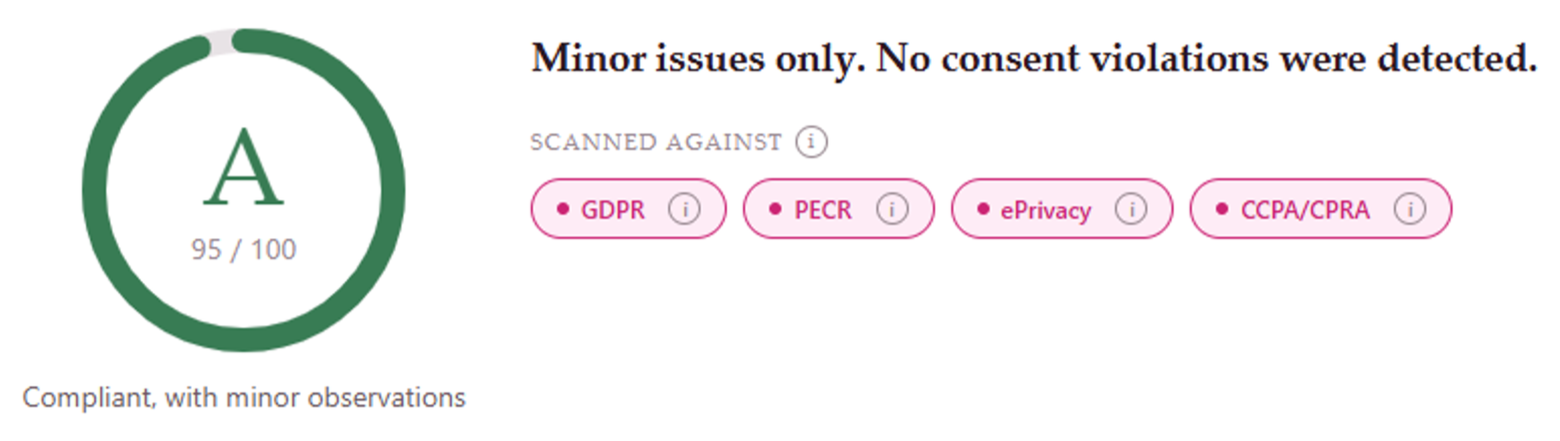
Once your site scan has finished - usually in under a minute - your site will be assigned a graded score. Using a weighted scoring model, with a value shown out of 100, your site will also be graded from F through to A.
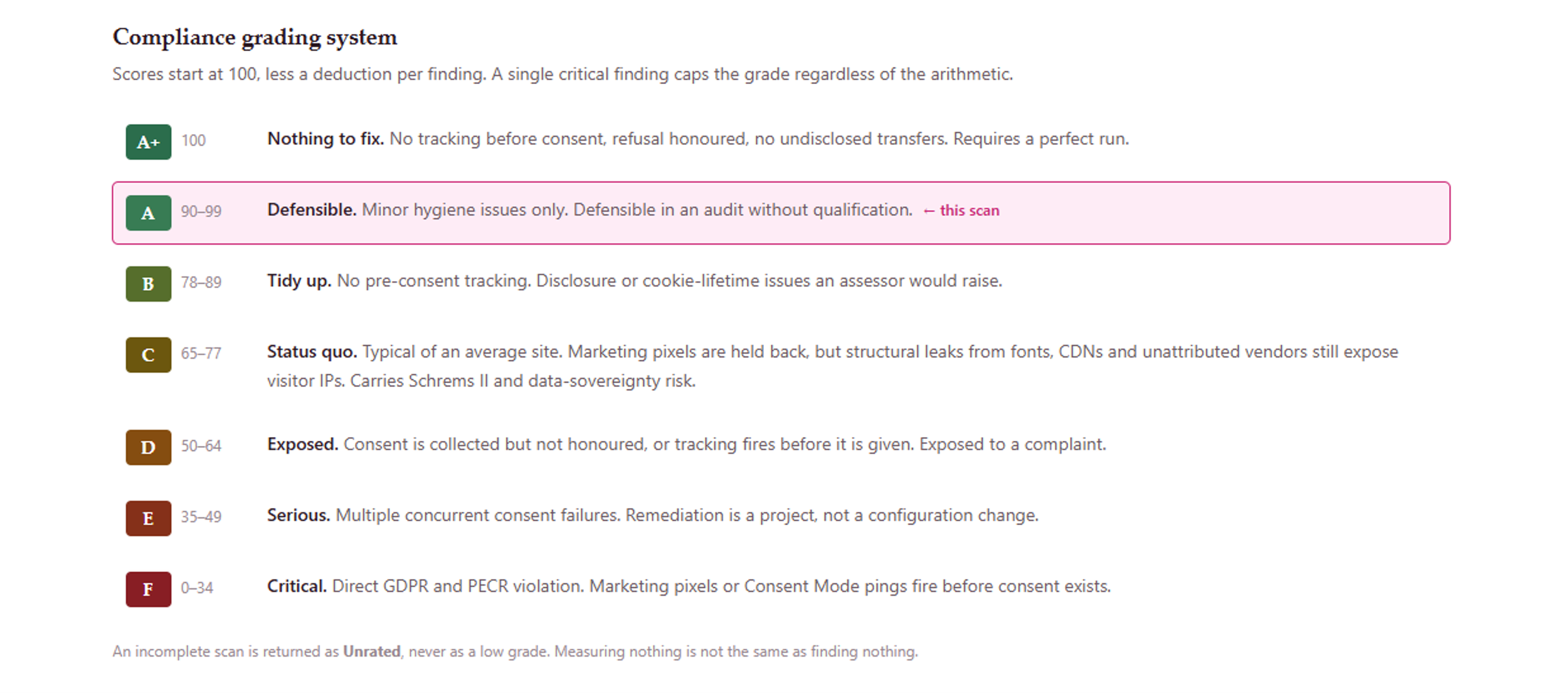
Your sites graded score can then be checked against our compliance grading system, which also provides a high level overview of the findings and context for your score.
Most importantly your scan report will also outline how to fix any data leaks or any issues found.
Why Privacy Pulse?
Who is Privacy Pulse for?
DataPal Privacy Pulse is designed for any website owner or stake holder who wants to understand if their site is privacy compliant.
For Brands or Organisations
Monitor your organisation's core websites. Manage privacy across brands, markets or business units. Protect a large or complex international website estate.
Know where you stand before someone else tells you
Marketing adds tags. Agencies add tags. Nobody removes them. Scan your own site and find out what is actually running before a complaint, an audit, or a customer asks the question for you.
For Agencies or Consultancies
Scan and monitor a smaller client portfolio. Manage bulk audits and multiple client workspaces. Deliver a white-labelled privacy service at scale.
Turn a compliance conversation into a work order
Scan a prospect’s site in under a minute and open the meeting with a graded, evidenced report. Bulk-scan your whole client book to see which accounts need attention first.
What this is not
This is a technical observation of what your website does in a visitor’s browser, at a point in time. It is not legal advice, and it does not assess your privacy notice, your records of processing, or anything that happens on your servers. When a site’s bot protection blocks us, we say so and mark the scan unrated. We will never tell you that you passed a test we could not run.
Your report
What you get
01
An overall site score and grade
Your site will be assigned a value out of 100 and assigned a grade from F through to A.
02
A report you can share
A graded PDF with every finding, the regulation it engages, and what your developers need to change. Not a wall of network requests.
03
Findings written for two audiences
Each finding says what happened in plain English, then says how to fix it in terms a developer can act on the same afternoon.
04
A complete cookie inventory
Every cookie, its vendor, its purpose and its lifetime: the raw material for the cookie notice Article 13 requires you to publish.
05
Dark-pattern detection
We count the clicks to accept and the clicks to refuse. If refusing takes longer, that asymmetry is itself a finding regulators have fined for.
06
Evidence you can stand behind
Every report carries a fingerprint of the underlying capture, so the findings can be shown to correspond to a specific, unaltered scan.
07
Bulk scanning for portfolios
Agencies and multi-brand groups can queue hundreds of domains at once and get one comparable grade per site.
08
Site monitoring
Sites change and so will their privacy score and grade. You can monitor your site over time.
FAQs
DataPal Privacy Pulse FAQs
About Privacy Pulse
-
DataPal Privacy Pulse is a website scanner that reveals privacy risks and data leaks occurring before a visitor has given permission.
It shows whether a website is sending information to analytics, advertising or other third-party services too early. It then provides clear, practical guidance to help you investigate and fix the problems it finds.
-
Privacy Pulse looks for activity that happens before a visitor has made a privacy choice.
This can include:Cookies being created too early
Tracking technologies loading without permission
Data being sent to third parties
Analytics or advertising tags firing prematurely
Consent and tag-management settings that may have been incorrectly configured
Potential privacy or regulatory risks
The findings are presented in clear language, with more detailed information available for technical teams.
-
When someone first visits a website, they have not yet had an opportunity to accept, reject or manage their privacy choices.
With limited exceptions, technologies that are not strictly necessary should not normally be activated before the visitor has made a choice. If information is collected or shared too early, the website may be failing to respect the visitor's preferences and could create regulatory, reputational and commercial risk.
-
Many cookie and consent tools concentrate on identifying cookies or reviewing what happens after a visitor has interacted with a consent banner.
Privacy Pulse is deliberately focused on the critical period before a visitor has made a choice. It examines what the website actually does when someone first arrives, including whether information is transmitted to third parties prematurely.
This focused approach helps identify problems that may otherwise be missed.
-
No. Privacy Pulse is an independent scanning and diagnostic product. It does not replace your Consent Management Platform, or CMP.
It helps you check whether your website, CMP, tag manager and connected technologies are behaving as intended. If it identifies a problem, the findings can help your privacy, marketing and technical teams understand what needs to be investigated.
-
Privacy Pulse is designed for:
Brands and organisations operating websites
Digital, media and marketing teams
Privacy, legal and compliance teams
Web developers and technical teams
Digital agencies and consultancies
Consent Management Platform providers
Organisations managing multiple websites or client domains
You do not need technical expertise to understand the headline result. Detailed evidence is also provided for the people responsible for resolving the issues.
Scores and results
-
The score provides a simple indication of how the website behaved during the scan.
A stronger score means that Privacy Pulse found fewer signs of technologies operating or transmitting data before the visitor had made a choice. A weaker score means that potentially significant issues were detected and should be investigated.
The score is a practical diagnostic indicator. It is not a legal judgment or formal certification of compliance.
-
Depending on the plan you use, your results may include:
An overall Privacy Pulse score and grade
A plain-English explanation of the result
A breakdown of the issues detected
Details of cookies, trackers and third-party connections
Evidence showing what happened during the scan
An indication of the seriousness of each finding
Practical guidance on what to investigate or change
A downloadable report for colleagues, clients or suppliers
Monitoring and comparison over time
The available features will depend on the plan selected.
-
When someone first visits a website, they have not yet had an opportunity to accept, reject or manage their privacy choices.
With limited exceptions, technologies that are not strictly necessary should not normally be activated before the visitor has made a choice. If information is collected or shared too early, the website may be failing to A high exposure rating based on your score and grade means Privacy Pulse detected activity that may require urgent investigation. For example, cookies may have been created or information may have been transmitted before the visitor had given permission.
It does not automatically prove that an organisation has broken the law. Some technologies may be strictly necessary or have another valid explanation. The findings should be reviewed in context by the appropriate privacy and technical specialists.
-
No automated scan can guarantee complete legal or regulatory compliance.
A good Privacy Pulse score means the scanner did not identify significant pre-permission problems within the scope and conditions of that scan. It does not assess every aspect of your website, privacy notice, internal data use, security, accessibility or wider compliance programme.
Websites also change frequently, so a good result today does not guarantee the same result in the future.
-
Different tools may test different parts of a website, use different locations or environments, classify technologies differently, or focus on different stages of the consent journey.
Privacy Pulse has a specific focus: what happens before the visitor has made a privacy choice. This can reveal activity that a broader cookie inventory or post-consent scan may not highlight.
-
Yes. Privacy Pulse reports are designed to help privacy, marketing and technical stakeholders work from the same evidence.
The headline result explains the problem in accessible language, while the detailed findings can help developers, agencies, CMP specialists and tag-management teams identify where corrective work may be needed.
-
Yes. Agency and consultancy plans are intended for organisations that manage or advise multiple clients. Privacy Pulse provides a presales audit weapon to expose prospect vulnerabilities and win new accounts. By monitoring client websites agencies can provide continuous Compliance-as-a-Service (CaaS).
Privacy Pulse can support:
New-business and prospect reviews
Client privacy audits
Website launches and migrations
CMP and tag-management checks
Quality assurance
Remediation projects
Ongoing monitoring and reporting
You should always use scan results responsibly and avoid presenting an automated finding as a final legal conclusion.
Privacy, security and compliance
-
Privacy Pulse performs scans using its own controlled environment. It does not need to monitor or profile the real visitors to the website being tested.
The purpose of the scan is to observe how the website and its connected technologies behave, not to collect information about individual users.
-
Information about scans may be retained to provide results, operate the service, prevent misuse, improve detection and support comparison over time.
Domains and scan findings may also contribute to DataPal’s benchmark database. This is used to produce high-level statistics, patterns and trends about website privacy performance. Benchmark reporting is intended to provide market-level insight rather than disclose confidential customer information.
Further details should be set out in the Privacy Pulse Terms of Service and Privacy Notice.
-
No. Privacy Pulse provides technical observations, risk indicators and practical guidance. It does not provide legal advice or make a binding determination about regulatory compliance.
Where necessary, organisations should review the findings with their Data Protection Officer, legal adviser or other qualified privacy professional.
For DPO’s Privacy Pulse provides an audit-ready paper trail that helps prove accountability to regulators.
-
Privacy Pulse can help identify website behaviour that may be relevant to privacy and electronic communications requirements, including the UK GDPR, EU GDPR, PECR and equivalent rules governing cookies and similar technologies.
The precise legal position depends on the organisation, visitor, jurisdiction, technology and purpose involved. Privacy Pulse highlights issues for investigation; it does not replace a full legal assessment.
-
Yes. Scan results and reports can provide evidence of what was observed at a particular point in time. This may support internal governance, supplier discussions, remediation work and ongoing assurance.
However, a Privacy Pulse report should form part of a wider accountability programme rather than being treated as complete evidence of compliance on its own.
How the scan works
-
Privacy Pulse visits the publicly available website using a controlled scanning environment. It observes what happens as the website loads before a visitor has made a privacy choice.
It uses a full headless Chromium browser that executes JavaScript and handles dynamic single-page applications, and as such Privacy Pulse is not just another static web crawler.
It records relevant cookies, requests, trackers and data connections, then analyses that activity for possible privacy risks, premature data transmissions or unauthorised network requests and configuration problems.
Privacy Pulse also detects HTML5 Local Storage, IndexedDB, and hidden tracking pixels.
-
No. A standard scan does not require you to install code, provide login credentials or make changes to your website.
You simply enter the public website address you want to check.
-
A normal scan behaves like a small number of ordinary website visits. It does not change your website, access private administrative areas or attempt to interfere with its operation.
Very large or repeated scanning activity may be subject to plan limits and our fair-use policy.
-
Privacy Pulse analyses information made available by publicly accessible websites. This means it can be used to carry out an initial scan of a public domain without installing anything on that site.
However, you must use Privacy Pulse lawfully and responsibly. You should only undertake more extensive monitoring, act on detailed findings or represent yourself as acting for a website where you have the appropriate authority.
DataPal may restrict or block scans involving unlawful, harmful, abusive or otherwise unsuitable websites.
-
No. Standard scans are limited to publicly accessible website pages and activity that occurs as those pages load.
Privacy Pulse does not log into user accounts, enter passwords, bypass security controls or access private areas of a website.
-
Privacy Pulse can scan most publicly accessible websites, but some sites may prevent or limit automated access. Results may also be affected by:
Security or bot-protection services
Geographic restrictions
Temporary website errors
Technologies that load only after particular interactions
Login requirements
Highly customised consent journeys
If a complete scan cannot be performed, the result should indicate that further investigation may be needed.
-
Privacy Pulse explicitly scans from a European datacentre (Belgium) to forcefully trigger and test strict GDPR compliance banners.
-
Many issues are caused by configuration rather than deliberate behaviour. Common causes include:
A tag added outside the consent controls
Incorrect rules in a tag-management platform
A new marketing tool that has not been properly classified
Consent settings that do not match the website configuration
Third-party scripts that activate other technologies
Changes made during a website update
Different settings across pages, templates or domains
Even a website with a recognised CMP can experience these problems.
-
Privacy Pulse identifies and explains the problems, but it does not automatically change your website or third-party systems.
Privacy Pulse identifies and explains the problems, but it does not automatically change your website or third-party systems.
Its guidance can help your internal team, developer, digital agency, CMP provider or privacy adviser investigate and correct the configuration. Depending on your plan and requirements, DataPal or one of its partners may also be able to provide additional support.
-
Websites rarely remain static. New campaigns, tags, plugins, suppliers and software updates can introduce privacy problems without anyone noticing.
Regular monitoring helps you identify regressions, check that configured settings remain effective and maintain a record of how the website has performed over time.
-
If the test site is publicly accessible to the scanner, Privacy Pulse may be used as part of your pre-launch quality assurance.
This can help identify problems before a new website, CMP configuration, tag-management setup or marketing campaign is released to the public. Password-protected or internally hosted environments may require a different arrangement.
Fixing and monitoring problems
Plans and purchasing
-
Privacy Pulse offers a free entry point so that you can assess a website and understand its headline position.
Paid plans provide additional capabilities for organisations that need more detailed findings, reports, repeat scans, multiple domains, ongoing monitoring or agency and consultancy use.
-
The right plan depends primarily on how many websites you need to manage and how frequently you want to scan them.
Brands and organisations can select a plan based on their own domains and monitoring requirements. Agencies and consultancies can select a plan designed for managing multiple clients.
If your requirements are more complex, DataPal can help you choose an appropriate plan or discuss a tailored arrangement.
-
Yes. Dedicated agency and consultancy options are available for businesses scanning or monitoring websites on behalf of multiple clients.
These plans are structured around multi-client use and can support prospecting, auditing, reporting, remediation and ongoing client services.
-
Each plan may include limits or allowances based on factors such as scans, domains, reports or monitoring frequency.
All plans are also subject to a fair-use policy. This helps us maintain a reliable service and prevent automated, excessive or abusive use. If your organisation requires unusually high volumes, please contact DataPal to discuss an appropriate arrangement.
-
Yes. Paid plans can support multiple domains, depending on the package selected.
This can be useful for organisations with several brands, country sites, campaign websites or digital properties, as well as agencies managing multiple clients.
-
Yes. DataPal can provide a demonstration of Privacy Pulse, explain how the scoring and reports work, and discuss how it could fit into your organisation’s privacy, website-management or client-service processes.
-
The report will identify the issue, show the available evidence and explain why it may matter. You can then share the findings with the team or supplier responsible for your website, CMP or tag-management configuration.
Where additional support is required, DataPal can discuss remediation, monitoring and relevant partner solutions with you.
-
Enter the address of the website you want to check and run your first scan.
You will receive a clear indication of how the website behaves before a visitor has made a privacy choice, along with guidance on any issues that may need attention.
Get your Free scan

See what your site does right now
Five scans a month, Free. No card, no sales call.
You will taken to Privacy Pulse