

We can build a quick App for that!
How many times are these words uttered in today’s world of fast, easy app creation and deployment? The motivation could be questionable, or even overtly dishonest, but it is usually completely legitimate and highly beneficial to the intended user community. Examples of positive motivations are prototypes of new service offerings, collecting additional personal data, or sharing useful, internally generated information with customers.

But web and mobile applications are very easy to implement badly!
Even a great concept and legitimate motivation for an app can result in a whole series of security and reputational risks for the owner. These can be caused by a lack of attention to the less exciting and creative elements of the development like user data security & management, access control; privacy & data protection; audit trail & governance. They can add a significant time and energy overhead to what is (at least initially) a tactical requirement without substantial budgets and project management resource.
How would it be if we could fast track the whole user data management challenge?
New global standards, data regulation and the emergence of personal data management tools have brought us to the point where the ‘less interesting’ parts of developing apps can be delivered by what is effectively a SaaS solution. This provides a plug-in capability for app developers to deliver the whole user data back-end to their UI / UX work. When the app needs to collect, use or change user data it does so via APIs with the user data services.
What are the advantages of this approach?
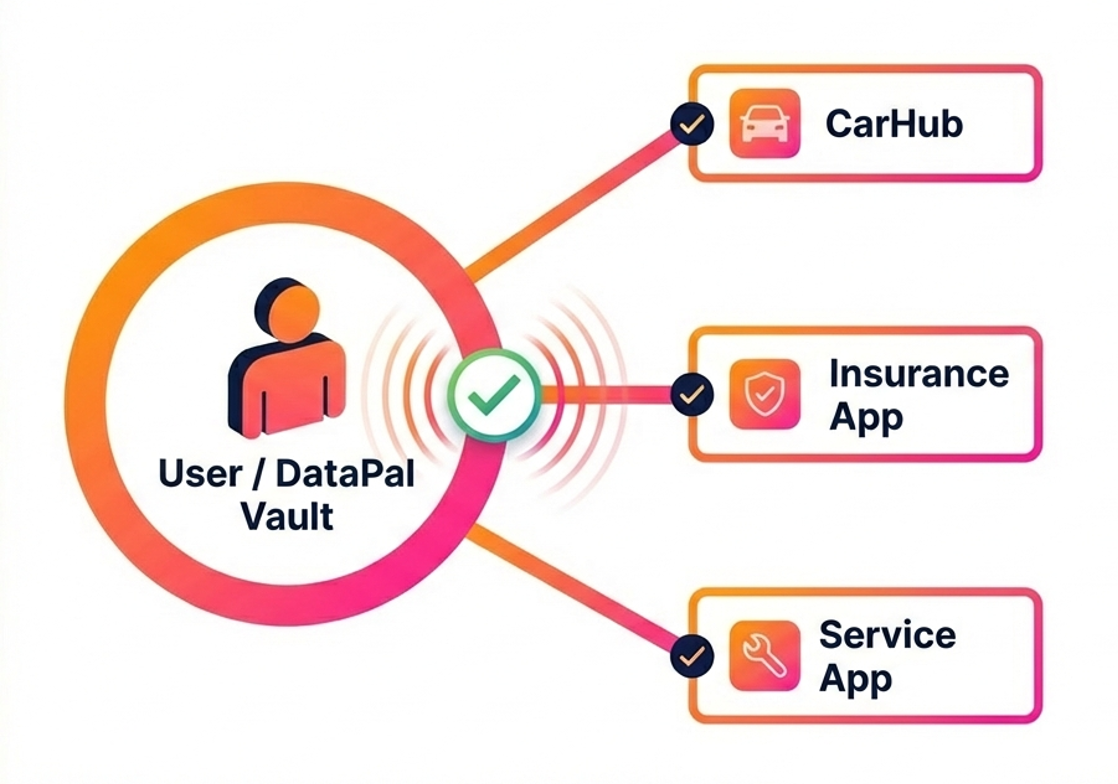
For corporate app owners a consistent user experience and governance approach is delivered to the user data management of every app developed. If customers need or want to use multiple of the organisation’s apps they only need to enter and manage their data once. And the connections are two-way so customers can be provided with data such as account balances, service reminders or smart receipts for new purchases.
For app developers time is saved in building the user data management capability of each app created. Standard API end-points and pre-built libraries are typically provided to speed up development. The resulting solutions provide clients with the re-assurance of class leading user security, consent and preference techniques.
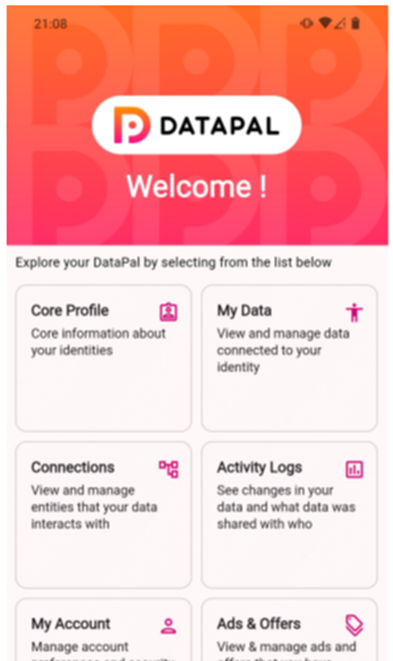
For customers a single user interface allows them to provide and manage their data for multiple web and mobile apps, potentially from multiple organisations, in one place. They gain complete control over how their personal information is used and can withdraw or limit it quickly from any or all the apps they use. Some of the solutions even offer personal AI Agents to help them use their information to ensure renewals are never forgotten or relevant deals missed.
Are these types of services available already?
This is still a relatively new area of service offering, but it is being accelerated by a clear evolution from Customer Relationship Management (CRM) and Customer Experience Management (CX) into Customer Empowerment (CE). Other developments, such as the publishing of the IEEEE P7012 standards and launch of MyTerms standards privacy agreements clear the way for even faster progress. An early example is the DataPal Personal Information Management Service from Personal Data Labs in the UK.
CarHub - An illustration of how DataPal delivers the capability
DataPal exploits the opportunity explained above, enabling most forms of app to adopt it as the user data engine, meaning accelerated development, improved user experience and in-built regulatory compliance.
In this example we illustrate how a market research company, for example, could exploit DataPal in a simple app to gather information from car owners. They want to ask owners to provide basic data on ALL the cars they own so they can segment respondents by the nature of their whole “Garage”.
The app, which they call CarHub, is developed without the need for their usual user data security testing and validation as the user data will all be stored on, and accessed from, DataPal. The tools and guidance for their developers ensure that this is straightforward and reliable.
Once the app is live, the target users are encouraged to download the CarHub app from their app store, initially offering an incentive for doing so. The app itself has no user security but as soon as they choose to enter any data they are effectively setting up a DataPal account and data store for their personal data. This data can be edited, supplemented or deleted, whenever they wish, from their DataPal account, giving the potential research respondents confidence about their control of their data in the future.
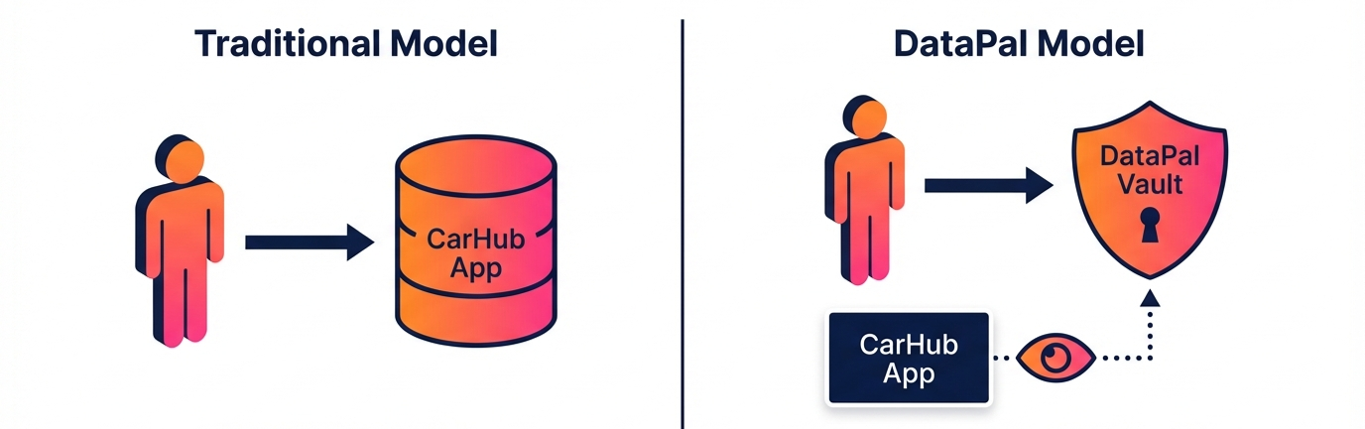
Users are then guided through the process of entering their basic personal information and adding each of their cars to the CarHub app. This enables the researchers to select specific customers for their research based on the nature of all cars owned or used. When the research is complete the CarHub users are encouraged to retain, or even supplement, their data by adding value and functionality to the app. This data can also be integrated to the users’ DataPal accounts to deliver the confidence and control that means it is more likely to be self-maintained by the users.
As further organisations and groups adopt DataPal, the research company’s contacts will be able to share their personal information, and or their car data, with those. No re-inputting will be needed and any changes they make to any or their data will be fed to each of the connections that they have chosen to establish.