

Article 88b: From Cookie Banner Theatre to Portable Privacy Signals
Why DataPal is Built for the Next Era of Machine-Readable Privacy.
For years, the internet has trained people to click “Accept All.”
Not because they truly understood or agreed to how their data would be used but because endless cookie banners, consent pop-ups and fragmented privacy settings made meaningful choice almost impossible.
The European Union now appears ready to change that.
With the introduction of proposed Article 88b as part of the EU’s Digital Omnibus package, Europe is signalling a major structural shift in how digital consent will operate online. Rather than relying on repetitive website-level prompts, the future points toward automated machine-readable “Privacy Signals” that communicate an individual’s consent and data preferences across websites, apps and services or trusted intermediaries.
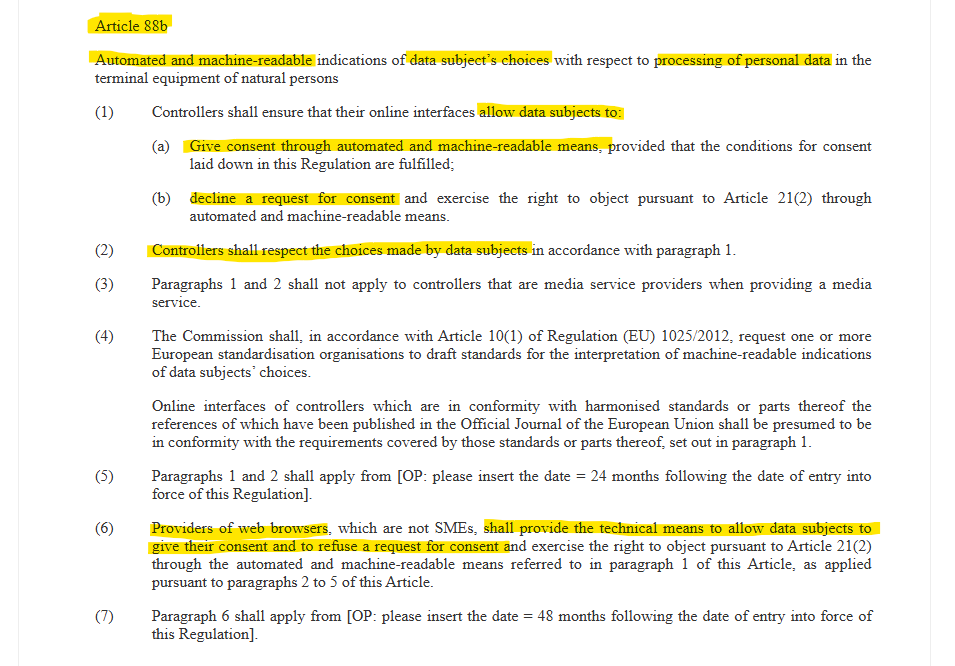
In simple terms: individuals will increasingly be able to say what they want once and have that choice respected everywhere.
In effect, privacy preferences become portable “Privacy Signals” that travel with the individual rather than being repeatedly collected by every website independently.
This is precisely the type of future that DataPal has been designed for.
From Cookie Banners to Persistent Privacy-minded Relationships
Article 88b aims to standardise and legitimise automated consent signalling mechanisms, such as browser-based privacy controls and machine-readable preference systems.
The proposal would require organisations to technically recognise and honour signals that communicate whether an individual:
accepts processing
refuses tracking
objects to profiling
or sets conditional privacy preferences.
The intention is clear: reduce “consent fatigue” and create a more efficient, transparent and user-centric digital ecosystem.
Importantly, this is not simply a UX improvement.
It represents a deeper architectural change: a move away from fragmented, website-by-website consent collection toward persistent digital privacy relationships.
That shift aligns directly with the philosophy behind DataPal, MyTerms and MyKey.
DataPal Was Built for Machine-Readable Privacy Signals
At its core, DataPal is designed to help individuals safely control, curate and share their data through transparent, permissioned relationships with organisations.
Instead of relying on static cookie banners or hidden legal notices, DataPal enables machine-readable agreements and interoperable data permissions that can operate dynamically between individuals and organisations.
This includes:
Persistent user-controlled permissions
Machine-readable privacy preferences
Identity-linked consent records at individual organisation-level
Transparent audit trails
Revocable permissions
Cross-service interoperability
AI-readable trust instructions
In many ways, Article 88b validates the direction the industry has already been moving toward:
privacy preferences that are portable, persistent and automatable.
Beyond Consent: Toward Negotiated Trustworthy Relationships
Most current consent systems are binary and transactional.
Accept or Reject.
Yes or No.
Click and continue.
But real digital relationships are more nuanced than that.
An individual may be willing to share certain data:
for service improvement,
for personalisation,
for loyalty rewards,
or for AI-driven assistance
while refusing third-party resale, cross-context advertising or indefinite retention.
This is where DataPal’s approach becomes particularly powerful.
Using machine-readable agreements such as IEEE 7012 “MyTerms”, individuals can express far more granular preferences and conditions than traditional consent frameworks allow.
For example:
“You may use my purchase history to improve recommendations.”
“You may not share my data with third parties.”
“You may retain my data for 90 days only.”
“You may contact me only regarding products I already own.”
“You may use anonymised insights but not identifiable profiling.”
Rather than forcing users into blanket acceptance, DataPal supports negotiated, transparent and contextual data relationships.
That is a major evolution from today’s cookie-banner economy.
Why This Matters for AI
Article 88b arrives at a critical moment.
AI systems increasingly depend on trusted access to high-quality personal data. Yet public trust in how organisations collect and use data has never been lower.
The future of AI cannot rely on opaque surveillance-based data collection. It will increasingly depend on trusted, machine-readable Privacy Signals that clearly define what data can be used, by whom, for what purpose, and under what conditions.
It requires:
explicit trust,
transparency,
portability,
accountability,
and machine-readable governance.
This is where DataPal’s infrastructure becomes highly relevant.
DataPal enables individuals to:
understand what data is being shared,
control who can access it,
revoke permissions dynamically,
and potentially allow trusted AI agents to manage those relationships on their behalf.
In effect, Article 88b helps lay the legal foundations for an ecosystem where privacy preferences become programmable infrastructure for the age of AI.
The Industry Concerns Are Real But Solvable
Not surprisingly, the proposed legislation has triggered significant debate.
Publishers, advertisers and industry groups such as IAB Europe have raised concerns around:
operational complexity,
cross-device conflicts,
authenticated identity mismatches,
consent record fragmentation,
and potential impacts on advertising revenues.
These concerns should not be dismissed.
A fragmented ecosystem of disconnected Privacy Signals could indeed create technical and governance challenges.
But this is precisely why interoperable trust infrastructure matters.
DataPal’s approach is not based purely on anonymous browser settings. It combines:
portable identity,
machine-readable permissions,
persistent records,
and user-centric trust relationships.
That creates the potential for more robust, auditable and cross-context privacy management than standalone browser signalling alone.
In other words: the answer to consent fatigue is not less infrastructure it is better infrastructure.
The Opportunity for Organisations
Many organisations will initially see Article 88b as a compliance challenge.
The smarter organisations will recognise it as something else entirely: an opportunity to rebuild customer trust.
The businesses that succeed in the next generation of digital services will likely be those that:
minimise friction,
reduce surveillance dependency,
respect user intent,
provide transparency,
and create clear value exchanges around data.
DataPal helps organisations move in exactly that direction.
Rather than treating privacy as a legal burden, organisations can begin using trusted data relationships as:
a customer experience (CX) advantage,
a loyalty mechanism,
an AI enablement layer,
and ultimately a growth strategy.
The Bigger Shift: From Platform Control to User Agency
Article 88b is about far more than cookie banners.
It signals a broader transition away from platform-centric data collection models toward user-centric digital ecosystems.
A future where:
individuals carry persistent privacy preferences,
permissions travel with the person,
AI agents act under fiduciary instruction,
and organisations compete on trust rather than opacity.
That future will not arrive overnight.
But the direction of travel is becoming increasingly clear.
DataPal was built with that destination in mind from the beginning.
And Article 88b may prove to be one of the clearest signals yet that the era of machine-readable trust and portable Privacy Signals has finally arrived.
Footnote and a Call to Action
If you are:
Designing smart data schemes
Regulating data exchange
Building platforms or AI systems
Then the question is NOT:
“How do we implement another scheme?”
But:
“Are we building towards a network or away from one?”
We’re currently partnering with a small number of Organisations and Partners to explore these ideas through targeted proofs of concept. If you’re thinking seriously about the future of Smart Data, AI, and individual data control - we’d be interested in hearing from you.