

What if my Estate Agent was an AI Agent?
Why buying a home might be the perfect way to understand the future of Agentic AI
For centuries we've relied on agencies whenever life became too complicated to manage on our own.
Estate agents.
Travel agents.
Recruitment agencies.
Advertising agencies.
Talent agencies.
Even government agencies.
Although they operate in very different markets, they all share one defining characteristic. They act on behalf of someone else.
The word agency itself comes from the Latin agere ‘to do’. An agent doesn't simply provide information. They take action. They represent a client, work towards an objective and exercise a degree of delegated authority.
For hundreds of years that agent has always been a person, or an organisation employing people.
Until now.
The emergence of Agentic AI introduces an entirely new kind of agent: software capable not simply of answering questions, but of carrying out tasks, interacting with other systems and increasingly making decisions within defined boundaries.
This shift is attracting enormous investment and, inevitably, considerable hype.
But perhaps the most interesting question isn't whether AI agents are coming.
It's whose interests they'll represent.
Buying a Home is the Perfect Example
At DataPal we've spent considerable time studying the residential property market.
Initially our interest wasn't AI at all.
It was data.
Working alongside experts in the sector, we mapped the high-level buying and selling journey for residential property - LINK HERE. Even using the Scottish process as an example, we identified nearly sixty distinct processes involving dozens of organisations, repeated requests for information, fragmented data flows and significant manual effort. England and Wales follow a similarly complex pattern.
The exercise revealed something interesting.
Buying a home isn't simply a transaction.
It's an orchestration problem.
Multiple organisations need information.
Some create it.
Others verify it.
Others consume it.
Much of that information moves slowly, gets duplicated, loses context or never reaches the next participant at all.
Recent Smart Data initiatives from the UK Government - UK.Gov - suggest this is beginning to change.
Now add Agentic AI into the equation.
Suddenly many of those manual processes become candidates for intelligent automation.
Not because AI replaces people, but because it can take responsibility for many of the repetitive tasks that sit between them.
Meet Alice
Imagine Alice has decided it's time to move home.
Today her process probably looks familiar.
She visits several estate agents.
She explains what she's looking for multiple times.
She creates accounts on various property portals.
Properties begin arriving from different places.
Many are duplicates.
She builds spreadsheets or handwritten notes comparing options.
She researches schools, transport links, crime statistics and local amenities herself.
She spends evenings trying to bring all of that information together into something resembling an informed decision.
It's time consuming.
It's fragmented.
And despite all that effort, she almost certainly won't discover everything that could have been relevant.
Now imagine Alice has appointed a fiduciary AI Buying Agent.
Not an AI working for an estate agent.
Not one working for a property portal.
One working exclusively for Alice.
Agency Needs Boundaries
Before that agent does anything, two questions need answering.
Who does it work for?
What authority has Alice delegated?
Those two questions may become the defining governance questions of the Agentic Economy.
Because an AI agent without clearly defined authority is no different from giving someone your house keys without telling them which doors they're allowed to open.
Alice might authorise her agent to:
search the market continuously
identify suitable properties
monitor price changes
compare transport, schools and local services
gather planning information
identify mortgage providers
shortlist properties that satisfy her requirements
arrange viewings that fit her diary
Equally important are the things it cannot do.
It cannot change her priorities.
It cannot commit her to purchases.
It cannot disclose information beyond the permissions she has granted.
Those boundaries matter because the real power of Agentic AI comes from allowing software to act independently.
The more autonomy we give agents, the more important governance becomes.
Agents Talking to Agents
Once properly authorised, something remarkable begins to happen.
Alice's Buying Agent doesn't attempt to do everything itself.
Instead it discovers and collaborates with specialist agents.
One agent may represent an estate agency.
Another might access planning information.
Another understands transport.
Another analyses neighbourhood trends.
Another checks environmental risks.
Another compares mortgage products.
Each specialises in one task.
Together they build a far richer understanding of the market than Alice could realistically assemble herself.
This is where concepts like Agent-to-Agent (A2A) communication become genuinely valuable.
Rather than Alice manually contacting twenty organisations, her trusted agent coordinates conversations with many other specialist agents on her behalf.
The result isn't simply automation.
It's orchestration.
Why Data Should Return to Alice
Perhaps the most important design decision comes next.
Where should all of this newly discovered intelligence live?
Today's internet typically pushes information into organisational silos.
Every service builds its own customer profile.
Every platform accumulates more behavioural data.
Every organisation wants to become the centre of the relationship.
We believe the opposite model will prove more sustainable.
Information gathered by Alice's agents should return to Alice's own protected environment.
There it can be combined with her preferences, previous decisions and wider life context before she decides what, if anything, to share onward.
That creates a fundamentally different relationship between individuals and organisations.
Organisations contribute expertise.
Individuals retain control.
Trust is the Missing Layer
As soon as AI agents begin taking actions on our behalf, one further capability becomes essential.
Auditability.
Alice needs to understand:
what her agent did
which other agents it interacted with
what data was requested
what data was shared
why recommendations were made
which permissions were relied upon
Without that transparency, trust quickly breaks down.
With it, AI becomes accountable.
This is why DataPal places so much emphasis on permissions, verifiable agreements and auditable interactions.
AI agents shouldn't simply be intelligent.
They should also be explainable.
The Role of the Conductor
Within the DataPal model, every individual has a primary fiduciary agent.
We call it The Conductor.
Its role isn't to know everything.
Its role is to coordinate.
The Conductor understands your goals, permissions, preferences and trusted relationships.
When appropriate, it engages specialist agents to perform individual tasks before bringing the results back into your private environment.
Those specialist agents may come from DataPal.
They may come from estate agents.
Mortgage providers.
Banks.
Government services.
Insurance companies.
Or entirely new businesses that don't yet exist.
The important point is that they work within clearly defined permissions and transparent agreements.
Beyond Property
Buying a home simply helps us understand the mechanics.
Exactly the same model applies elsewhere.
Imagine agents that:
maintain a living digital logbook for your home throughout ownership
continuously monitor whether you're on the best energy, insurance and broadband tariffs
search for career opportunities matching your evolving skills
monitor your digital security and identity
manage receipts, subscriptions and household finances
coordinate healthcare appointments and medical information
quietly take care of countless pieces of life administration while you get on with living
The common theme isn't automation.
It's representation.
These agents don't replace you.
They work for you.
The Future of Agency
The estate agency example teaches us something much bigger than residential property.
For generations we've understood that agencies represent different interests.
A buyer's agent.
A seller's agent.
A travel agent.
A recruitment consultant.
We instinctively ask who they work for because we know that shapes every recommendation they make.
The same question is about to become central to AI.
Soon we'll stop asking whether an organisation uses AI.
We'll start asking:
Whose AI is it?
Who pays it?
Who can instruct it?
Who can audit what it has done?
Whose interests does it ultimately represent?
Those questions will define trust in the Agentic Economy.
At DataPal we believe the most important AI agent you'll ever use is the one that works for you.
In practical terms then what might that look like?
Here are some screenshots from DataPal work in the area from that fiduciary side.
In the first, Alice has logged an Intent record. She can make that available to any verified connection that she wants and thinks can help. Ideally, this can be done under the MyTerms / IEEE 7012 agreement (PDC-INTENT) so that what the connection does with the data is constrained by contract.
In the first, Alice has logged an Intent record.
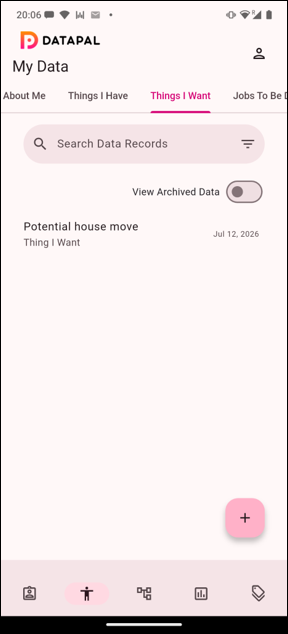
She can make that available to any verified connection that she wants and thinks can help. Ideally, this can be done under the MyTerms / IEEE 7012 agreement (PDC-INTENT) so that what the connection does with the data is constrained by contract.
This Intent data trigger two ‘Jobs To Be Done’
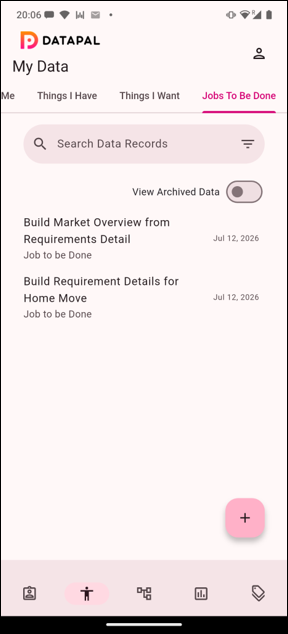
Alice’s Intent data has triggered two Jobs To Be Done records. These are how Agents are discovered then briefed in DataPal.
A buyers Agent has been appointed to help
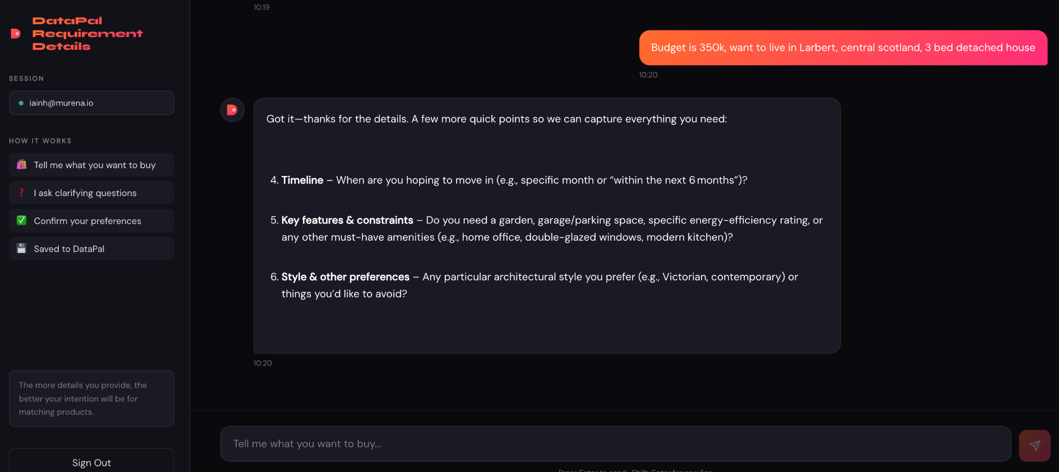
In this case the job to be done is to augment the basic Intent data with whatever essential and optional data will help identify good matches in the market to the stated requirement.
This results in an augmented requirement detail pushed back into DataPal
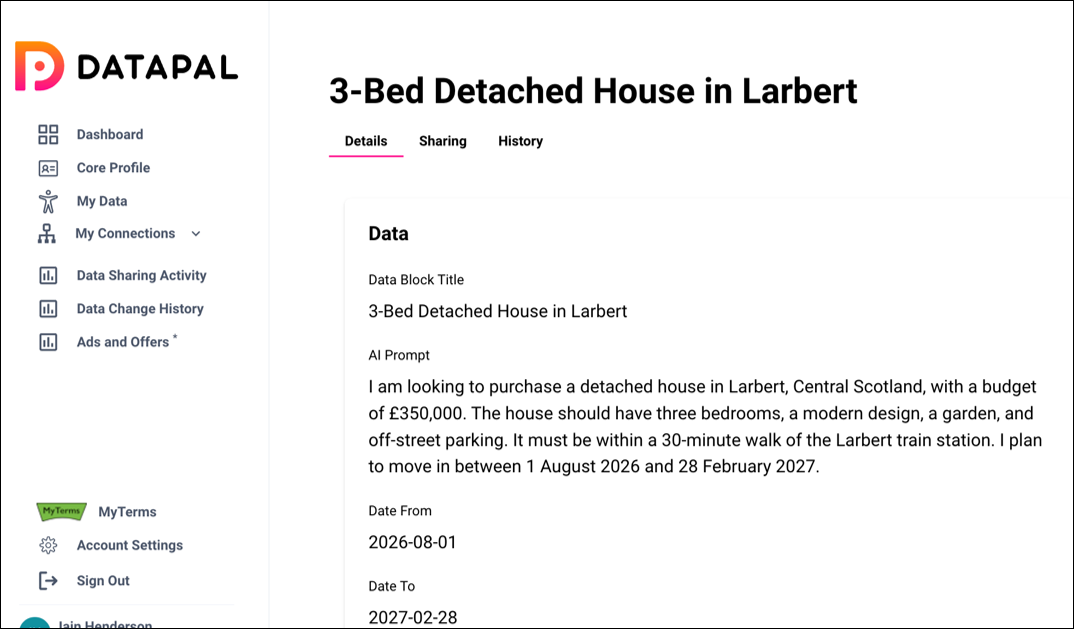
From there it can be shared with any other organisation, app, data service or Agent to add further value. For example, it might be shared with a number of potential mortgage providers (or their Agents) in order to begin that process.
A downstream ‘market availability’ Agent has now connected with multiple supply side and neutral Agents
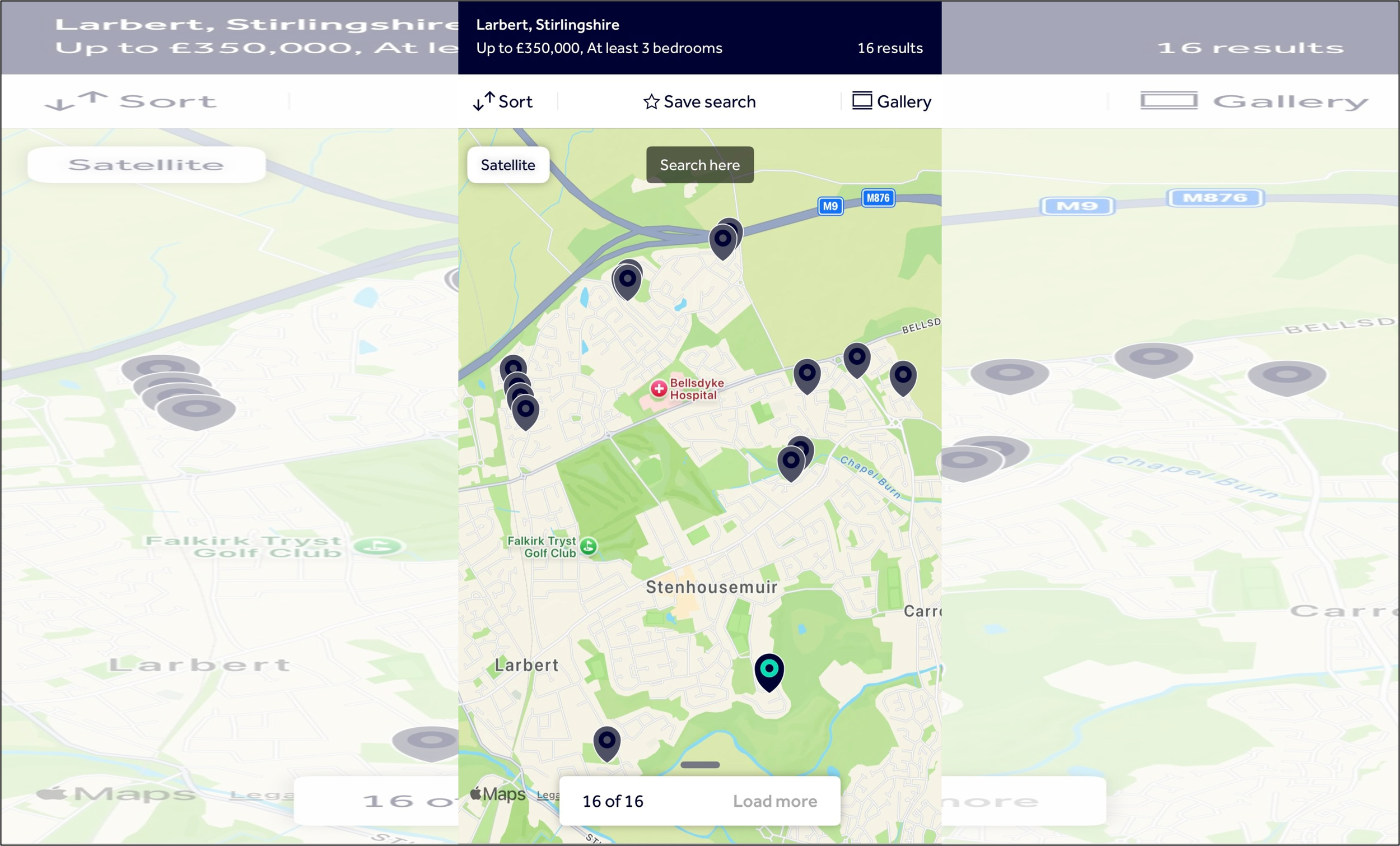
These Agents interacts with them, returning output (market availability) data into DataPal to feed into subsequent process steps. The Boss (Conductor Agent) then engages further downstream Agents, for example - one for scoring , ranking and filtering out options to build a short list. Finally a Booking Agent for viewings.
Footnote and a Call to Action
If you are:
Designing smart data schemes
Regulating data exchange
Building platforms or AI systems
Then the question is NOT:
“How do we implement another scheme?”
But:
“Are we building towards a network or away from one?”
We’re currently partnering with a small number of Organisations and Partners to explore these ideas through targeted proofs of concept. If you’re thinking seriously about the future of Smart Data, AI, and individual data control, we’d be interested in hearing from you.