

Traffic Lights for the Age of AI
Beyond Privacy Signals: From Protection to Trust to Intent in the Age of AI
In our previous article “Article 88b: From Cookie Banner Theatre to Portable Privacy Signals” we explored how the EU’s proposed Article 88b could mark the beginning of the end for endless cookie banners and fragmented consent experiences.
More importantly, we explored something bigger: the emergence of machine-readable Privacy Signals as a new interface between individuals, organisations and AI systems.
But Privacy Signals are only the starting point.
Because while protecting people from unwanted surveillance is important, the future digital economy cannot operate on protection alone.
The real opportunity lies in what comes next.
What happens when digital relationships evolve:
beyond compliance,
beyond permissions,
and beyond cookies
…toward trusted, intelligent and intention driven engagement?
At DataPal, we increasingly believe the answer can be understood through a very simple framework:
A new traffic light model for digital relationships.
The Signal Economy Is Emerging
For years, the internet has largely worked by trying to infer what people want.
Clicks. Tracking. Behavioural surveillance. Lookalike audiences. Predictive targeting.
Platforms and advertisers have spent decades attempting to reverse engineer human intent from fragmented data trails.
But AI changes the equation.
Because AI agents, machine-readable permissions and portable digital identities create the possibility for something fundamentally different:
people expressing preferences and intentions directly.
Not through surveillance.
But through signals.
This is the shift now beginning to emerge beneath:
Article 88b,
Smart Data initiatives,
AI governance,
machine-readable permissions,
portable identity systems,
and fiduciary AI concepts.
Signals are becoming the new interface between people, AI and organisations.
The Traffic Light Model for Digital Relationships
At its simplest level, the future evolution of digital relationships may look something like this:
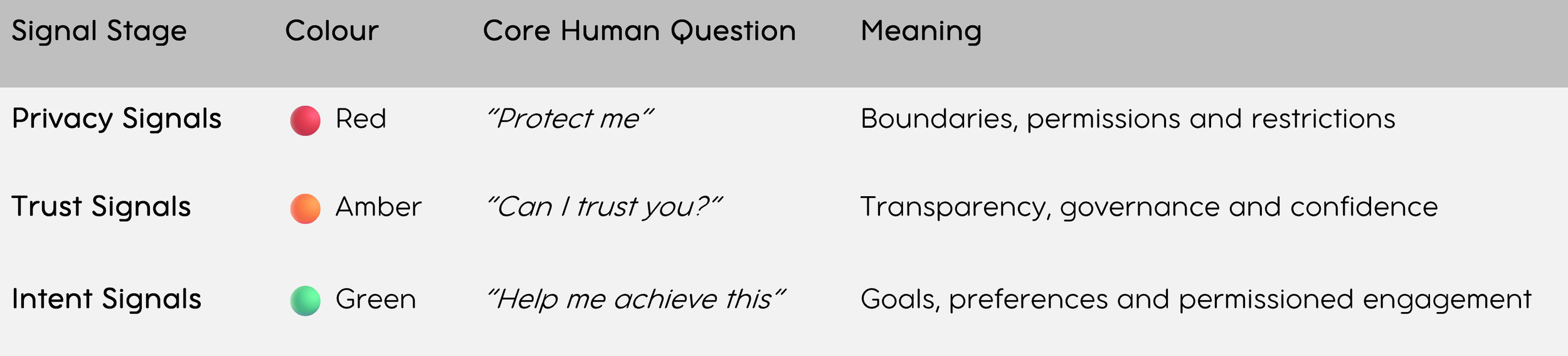
Importantly, this is not just a compliance framework.
It is a relationship framework.
And each stage represents a significant evolution in how organisations engage with people digitally.
Stage 1: Privacy Signals 🔴
“Respect my boundaries”
This is where the market is today.
Privacy Signals communicate:
what data processing is allowed
what tracking is refused
what permissions exist
and what boundaries should be respected
This is the world of:
GDPR
Article 88b
consent management
browser preferences
and machine-readable permissions
The goal is to eliminate “consent fatigue” by allowing individuals to communicate privacy preferences once and have those preferences respected automatically across services.
This is where frameworks such as MyTerms become increasingly important.
Instead of clicking “Accept All” hundreds of times a year, individuals can begin expressing persistent machine-readable privacy conditions directly.
That is a major shift.
But it is still primarily defensive.
Privacy Signals are fundamentally saying:
“Leave me alone unless I permit otherwise.”
Necessary? Absolutely.
But not sufficient for the next generation of digital relationships.
Stage 2: Trust Signals 🟠
“Earn my confidence”
This is where digital relationships begin to mature.
Because permission alone does not create trust.
A user may technically consent to data processing while still feeling:
uncomfortable
manipulated
uncertain
or powerless
Trust Signals go further.
They help individuals evaluate:
who they are dealing with
how their data will be used
whether AI systems are acting responsibly
and whether an organisation deserves ongoing access and engagement
This includes:
transparency
auditability
accountability
revocability
fiduciary behaviour
and visible customer control
In many ways, this becomes the missing layer between privacy compliance and meaningful customer relationships.
And increasingly, it may become one of the most important commercial differentiators of the AI era.
Because as AI systems become more powerful, customers will increasingly ask:
“Can I trust the intelligence interacting with me?”
Not just:
“Did I click accept?”
This is where trusted infrastructure, portable permissions and persistent digital relationships become strategically valuable.
It is also where DataPal’s broader philosophy around trusted digital relationships begins to come alive.
Stage 3: Intent Signals 🟢
“Help me achieve my goals”
This is where things become transformational.
Intent Signals move beyond protection and governance toward active collaboration.
Instead of organisations trying to predict what people might want through surveillance data, individuals, or their AI agents, can communicate goals directly.
Examples might include:
“I want to reduce my energy bills.”
“I am looking for a better mortgage.”
“Help me plan a sustainable holiday.”
“Find products aligned to my dietary needs.”
“I am actively considering an electric vehicle.”
This changes the economics of digital engagement completely.
Instead of interrupting people with speculative advertising, organisations can respond to explicit, permissioned expressions of intent.
That creates:
better customer experiences
more efficient marketing
reduced waste
and potentially far stronger trust relationships.
This is also where the ideas behind the “Intention Economy,” pioneered by Doc Searls, become highly relevant: markets where customers express demand directly instead of being profiled indirectly.
In many ways, Intent Signals may ultimately become the most valuable signals of all.
Where AI Agents Fit
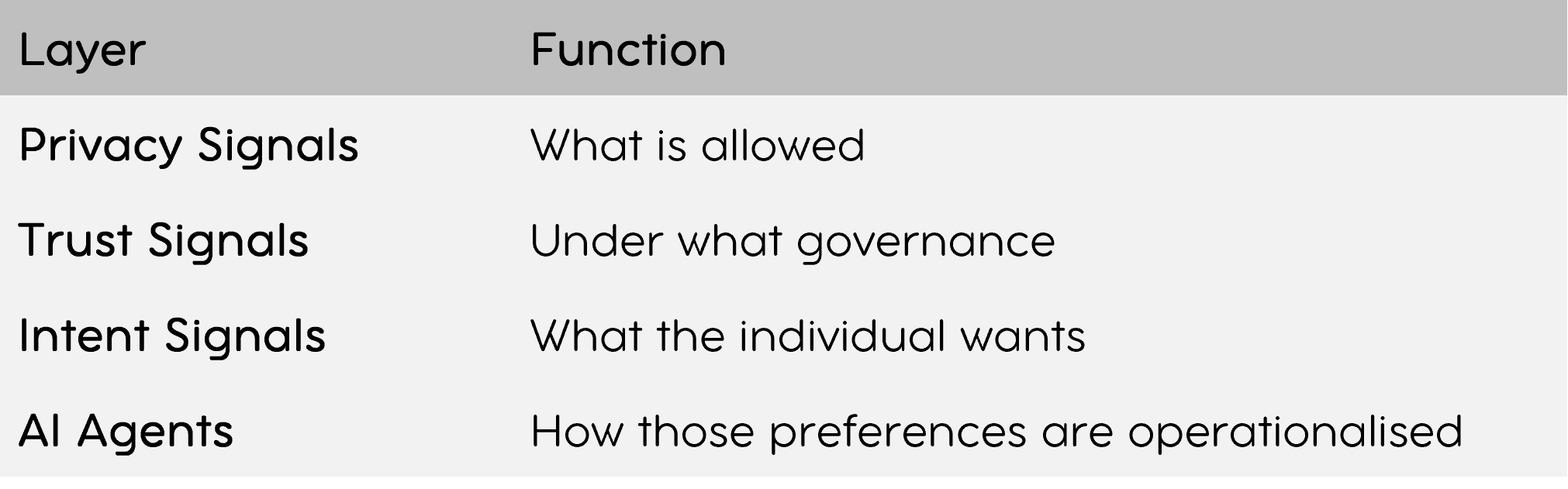
AI agents become the operational layer sitting across this entire framework.
They can:
manage permissions
negotiate terms
compare services
update preferences
revoke access
discover offers
and act under fiduciary instruction on behalf of the individual
In effect:
This is where concepts such as:
portable identity
machine-readable permissions
fiduciary AI
Smart Data infrastructure
and persistent digital relationships
begin converging into a much larger ecosystem shift.
Why “Data” Begins to Fade into the Background
One of the most interesting things about this evolution is that “data” itself increasingly fades into the background.
That may sound surprising for an industry built around data.
But from a human perspective, most people do not actually care about:
databases
interoperability
APIs
identity protocols
or consent architectures
They care about:
protection
confidence
convenience
and outcomes
That is why the language of signals matters.
Signals humanise the infrastructure.
They translate technical systems into understandable relationship dynamics.
And that may prove critical for mainstream adoption.
The Bigger Shift
Ultimately, this is about more than cookie banners.
More than compliance.
And even more than privacy.
It is about the evolution of digital relationships themselves.
A shift away from:
opaque surveillance
platform centric control
and inferred behaviour
toward:
explicit permissions
trusted interactions
portable digital relationships
and declared human intent
That is a very different model for the internet.
And perhaps a far more valuable one for everyone involved.
Footnote and a Call to Action
If you are:
Designing smart data schemes
Regulating data exchange
Building platforms or AI systems
Then the question is NOT:
“How do we implement another scheme?”
But:
“Are we building towards a network or away from one?”
We’re currently partnering with a small number of Organisations and Partners to explore these ideas through targeted proofs of concept. If you’re thinking seriously about the future of Smart Data, AI, and individual data control, we’d be interested in hearing from you.