

Introducing Privacy Agent from DataPal
Have you ever wondered if all those ‘Accept all’ or ‘Necessary cookies only’ buttons we must click actually make any difference?
Maybe you do if you’re a privacy geek like me. I suspect most people just click whatever gets rid of the banner so they can get to what they came for.
I think people are rationally disengaged. You came to read an article or use a service. You’ll face much the same question on the next site, and you rarely get to see whether this site did what you asked. Of course you want to get on with your day.
That made me wonder what’s happening on the other side of the banner. How often does what the site actually does match the choice it offers you?
Take this example from our Privacy Pulse team. We scan what a site does:
Before you make a choice,
After you Accept All and thirdly
After you Reject All.
A+ is our benchmark for the behaviours we test. Two of the checks are straightforward to explain.
If a cookie or similar technology requires consent, wait for it.
If someone refuses consent for tracking, respect that choice.
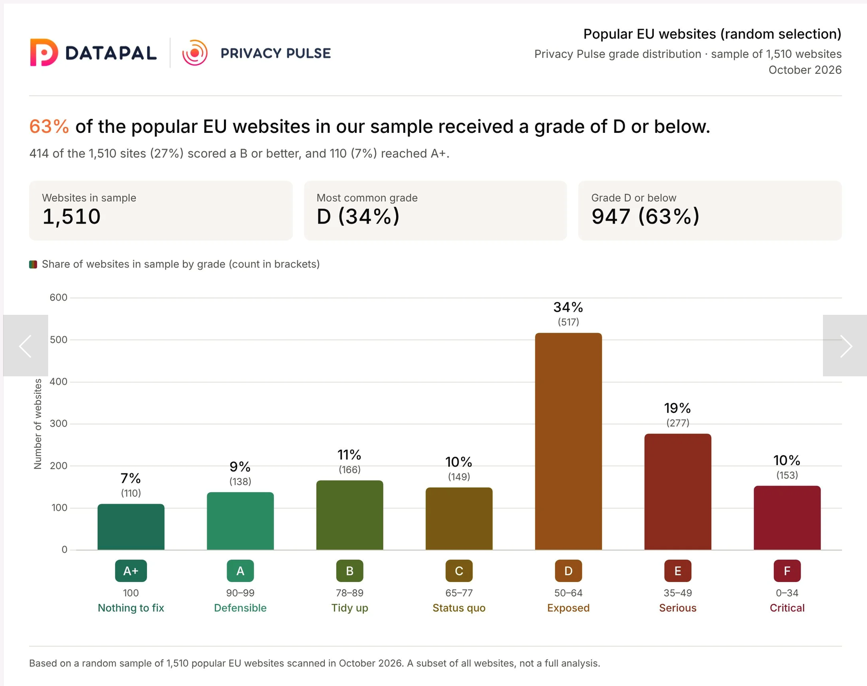
A small share of the sites in this scan met all the checks (16%). Many got some things right (21%) and fell short on others with the majority being Exposed (34%). In this sample, 29% failed with a grade of E or F.
The people working on these problems have given us two things to build on. Tools like Privacy Pulse make website behaviour visible. IEEE 7012, known as MyTerms (Reference: IEEE 7012-2025, IEEE Standard for Machine Readable Personal Privacy Terms.), gives individuals and organisations a standard for expressing personal privacy terms in a form software can read.
So, what if I could give a piece of software my instructions once and have it express them for me when I visit a site?
That’s what we’ve build with Privacy Agent from DataPal.
Here’s how a visit could work. I set my privacy preferences in my browser. When I visit a participating site, my agent communicates those choices and can propose a standard agreement. If the site can honour my choice and meet its obligations without asking me again, I can get straight to what I came for. On other sites, I may still see the usual banner.
The bigger idea goes beyond websites. In time, an app or AI service could come to my agent to ask for my terms. Before the agent acts on a request, I’d want it to be able to verify who is asking.
The European Commission is looking at a version of this idea, too. Its Digital Omnibus proposal includes a provision, Article 88b, for communicating privacy choices in a form software can read.
Here’s a quick preview of Privacy Agent.
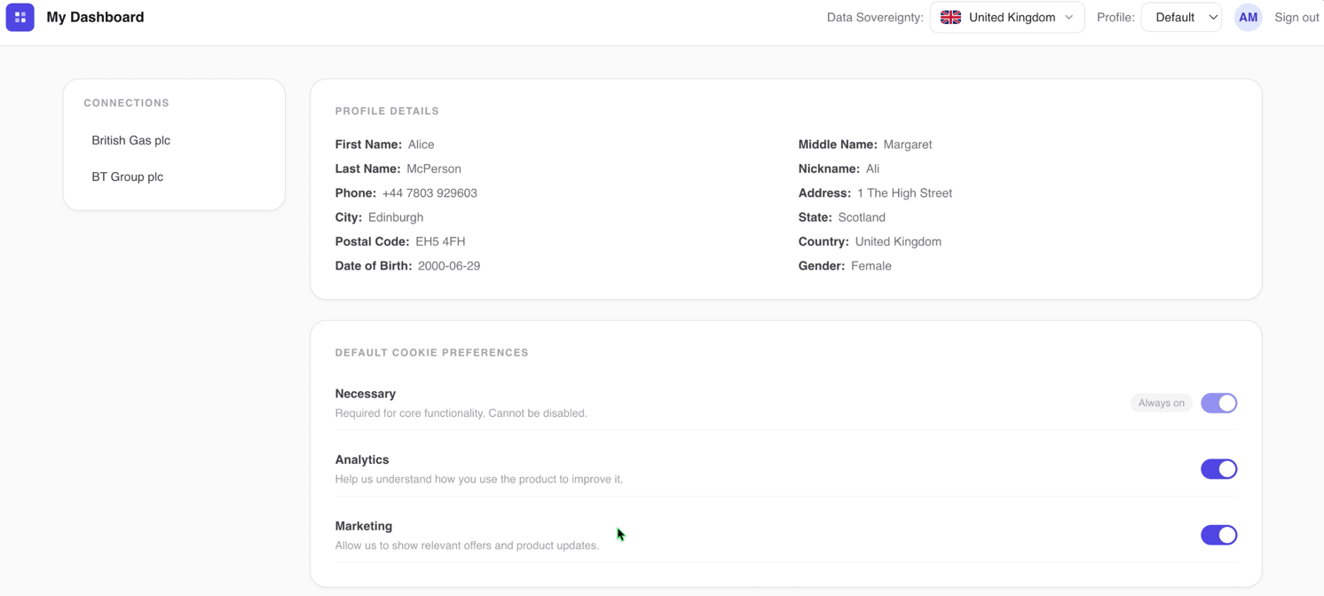
Privacy Agent works in your browser. We plan to add a mobile app over time.
You decide what instructions your agent follows and can change them.
The agent works with a specific set of information about you: your privacy permissions and preferences.
It uses browser request headers to introduce itself to participating sites and can propose a standard privacy agreement.
DataPal runs Privacy Agent on a fiduciary basis, with duties of care and loyalty to the individual. When a site asks for permission, the agent’s starting point is the choice you’ve made.
The agent keeps an audit record of its exchanges. Think of it as a bank statement for your privacy choices, where you can look back at what your agent communicated.
For me, the test of control is practical. Can I see what my agent shared? Can I change what it shares next time? And do I know whose interests it serves?
Privacy Agent will be available in December 2026, initially on a small number of participating sites. If you’d like to take part, get in touch with us at DataPal.