

Advertising After Surveillance
How human-controlled data, AI agents and MyTerms could reshape digital advertising and marketing
For centuries, markets have depended on one simple principle: people who have something to offer must be able to find people who want it.
Economists have long described this as supply and demand. Whether supply comes first or demand comes first matters less than the balance between them. Healthy markets depend on both sides having agency.
Digital markets no longer do.
Over the past two decades, the internet has created extraordinary tools for organisations to understand individuals. Brands, platforms, publishers and advertising networks have become increasingly sophisticated at observing behaviour, predicting intent and optimising engagement.
Individuals, however, have gained very little visibility or control in return.
Supply understands demand.
Demand rarely understands supply.
The result has been an increasingly one-sided digital economy characterised by surveillance, opaque data collection, declining trust and relationships defined by "take it or leave it" terms and conditions.
The response has been entirely predictable.
People reject cookies.
People block adverts.
People distrust platforms.
People become less willing to share their data.
The problem is not that advertising exists.
The problem is that the relationship has become unbalanced.
Advertising is a matching problem
Advertising is often thought of as persuasion.
In reality, its primary role is much simpler.
Advertising is a matching problem.
Helping the right organisation connect with the right individual at the right moment.
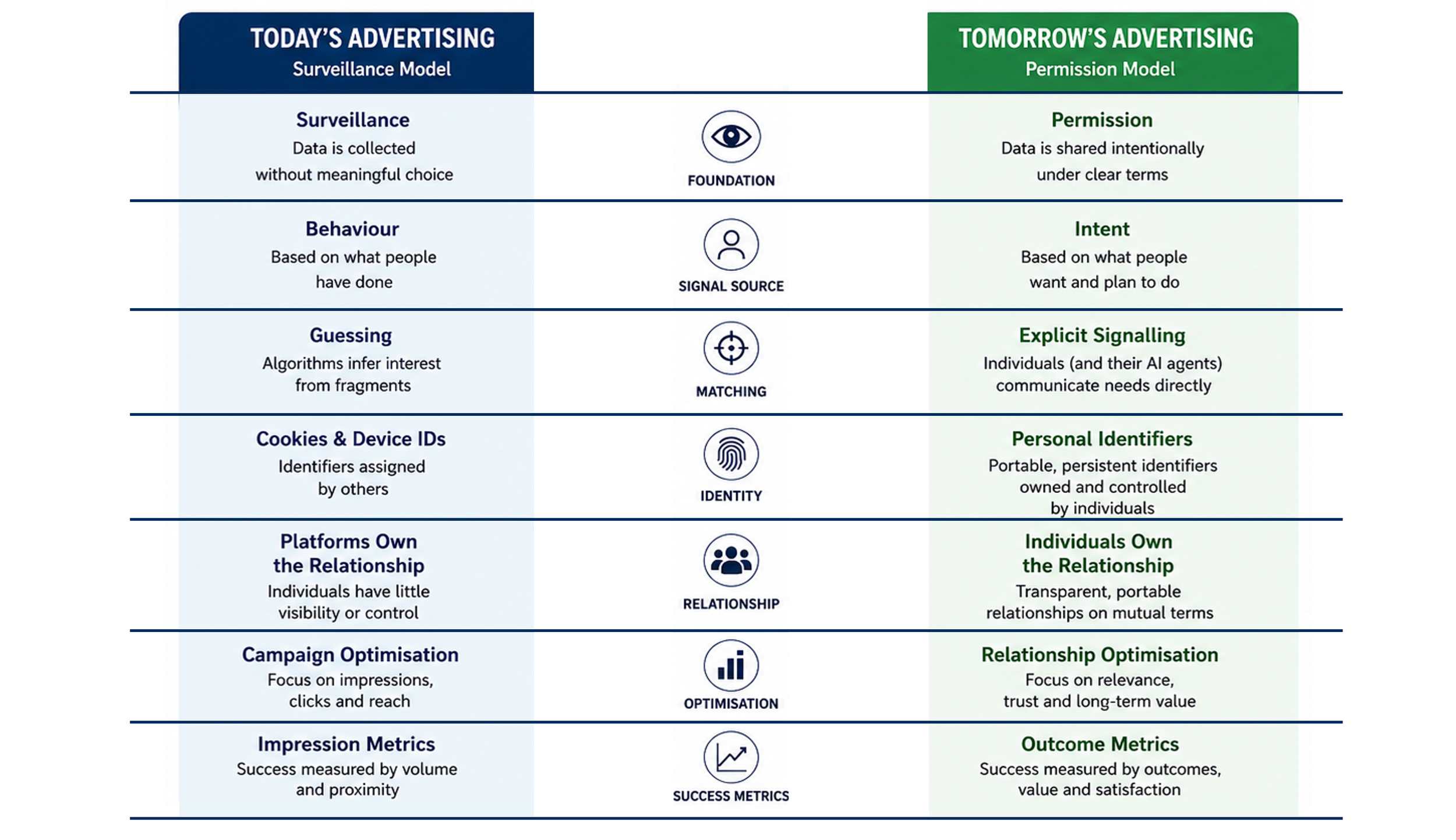
For years, the advertising industry has attempted to solve that matching problem by observing behaviour.
Cookies.
Device identifiers.
Mobile Advertising IDs.
Location history.
Browsing behaviour.
Purchase history.
The more signals collected, the better the prediction.
But prediction is always an approximation.
The future lies somewhere entirely different.
Not better surveillance.
Better signalling.
From surveillance to signalling
Imagine a market where individuals can safely and confidently express what they actually want.
Not what an algorithm guesses they might want.
What they explicitly intend.
Instead of organisations inferring interest from hundreds of fragments of behaviour, individuals can communicate rich, permissioned and machine-readable signals directly.
This restores balance.
Demand once again has a voice.
Supply gains access to significantly higher quality information.
Everybody wins.
This is where Trusted Data Relationships begin.
Rather than extracting information from individuals, organisations are invited into transparent, permissioned relationships where data is shared intentionally, under agreed terms and with accountability built in.
The result is not less data.
It is better relationships around data.
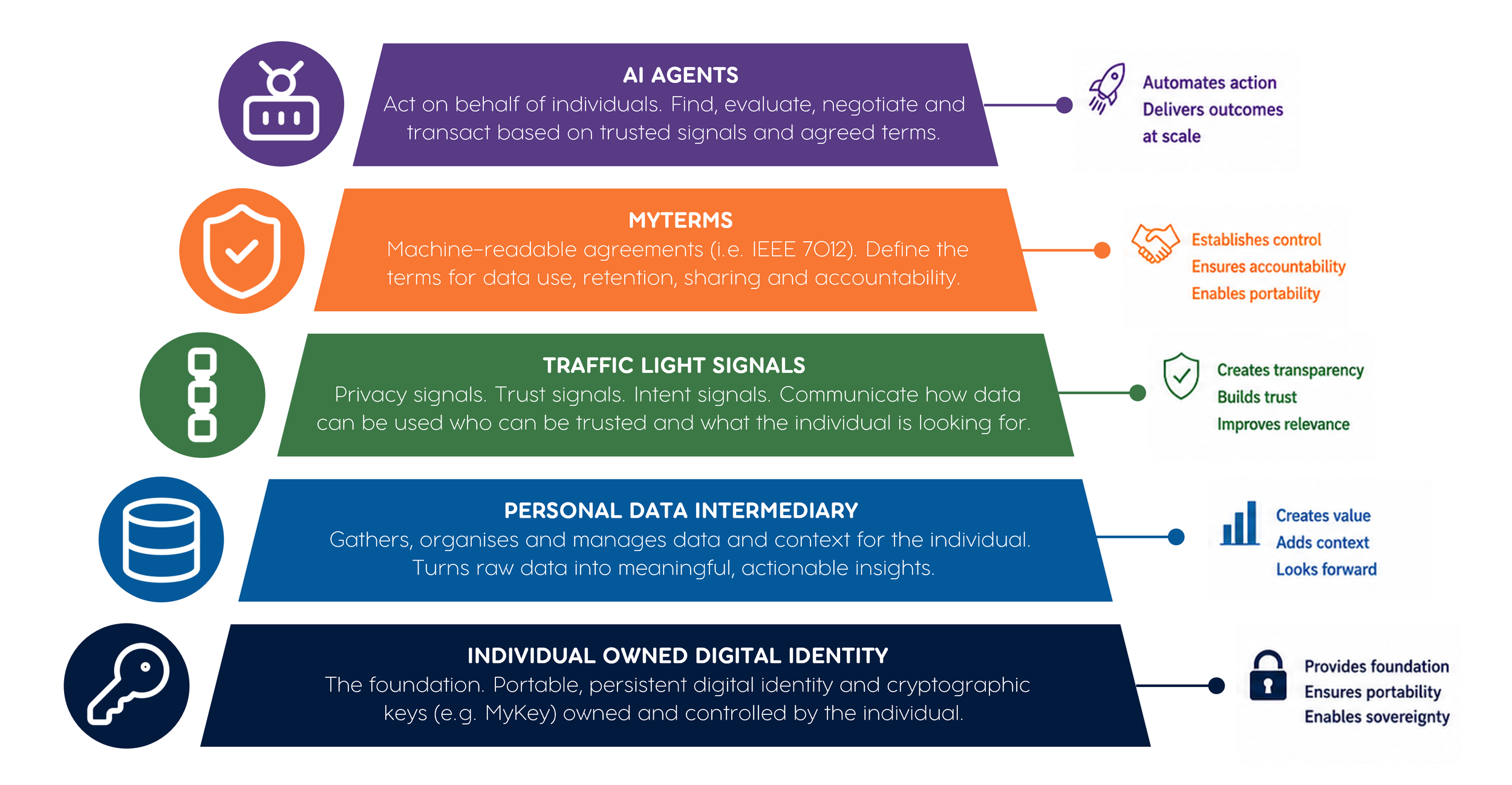
The Human-Centric Signals Stack
Creating this new model requires several complementary capabilities working together.
1. Individual-owned digital identity
Digital advertising has always depended upon identifiers.
Cookies.
Device fingerprints.
Mobile Advertising IDs.
The next generation of digital markets will increasingly depend upon identifiers that individuals genuinely own and control themselves.
Portable.
Persistent.
Permissioned.
Rather than being identifiers assigned by platforms, they become identifiers chosen by people.
2. Human-centric data intermediaries
Individuals possess far richer information about themselves than any platform can ever observe.
Their aspirations.
Life events.
Plans.
Preferences.
Household circumstances.
Upcoming purchases.
Changing priorities.
Modern data intermediaries enable individuals to gather, organise and manage this information on their own behalf.
Importantly, this shifts advertising from looking backwards at historic behaviour towards looking forwards at future intent.
3. Shared languages
Rich data becomes valuable only when other systems understand it.
Common ontologies, taxonomies and industry standards allow individuals to express demographics, interests, preferences and intentions in ways that organisations can readily consume.
Human-centric advertising becomes technically compatible with existing marketing infrastructure while fundamentally changing who controls the relationship.
4. Personal AI agents
Perhaps the most profound change will come from AI.
Today's advertising assumes that humans browse websites and respond emotionally to advertisements.
Tomorrow's digital economy will increasingly include AI agents acting on behalf of individuals.
These agents won't respond to emotional persuasion.
They will consume facts.
Compare options.
Evaluate trust.
Assess value.
Negotiate terms.
Complete transactions.
Search was the language of the web.
Intent will become the language of AI.
From prediction to articulation
Today's advertising asks:
"What might this person want?"
Tomorrow's AI asks something very different.
"What has this person already told me they want?"
That distinction changes everything.
Instead of organisations attempting to predict intent through surveillance, individuals will increasingly articulate their needs before entering the market.
Whether purchasing insurance.
Planning a holiday.
Buying a new car.
Moving house.
Choosing healthcare.
Selecting a university.
Personal AI agents will help individuals express detailed requirements long before suppliers begin competing for their attention.
Demand becomes explicit.
Matching becomes dramatically more accurate.
Advertising becomes dramatically more relevant.
Traffic Lights for the Age of AI
In previous articles we've explored the concept of portable Traffic Light Signals.
These become even more important in this emerging model.
🔴 Privacy Signals
How can my information be used?
Who can access it?
Under what conditions?
🟠 Trust Signals
Is this organisation trustworthy?
Can it verify how it will handle my data?
Does it meet my standards?
🟢 Intent Signals
What am I actively looking for?
What am I planning?
Which organisations am I willing to hear from?
Together these signals create a far richer and more transparent marketplace than behavioural surveillance ever could.
Why MyTerms matters
Signalling alone is not enough.
Individuals also need confidence that sharing information will not result in losing control of it.
This is where machine-readable agreements such as MyTerms become fundamental.
Rather than accepting organisation-defined terms, individuals can increasingly share information under their own transparent, portable and verifiable conditions.
The IEEE 7012-based MyTerms framework enables organisations and individuals to establish trusted relationships where permissions are explicit, auditable and mutually understood.
This changes data sharing from extraction into collaboration.
From Campaign Management to Relationship Management
Perhaps the biggest opportunity lies beyond advertising itself.
The same human-centric infrastructure has the potential to transform:
Advertising
Marketing
Customer Relationship Management
Customer Experience
Analytics
Loyalty
Fraud prevention
AI agent interactions
Today's digital businesses optimise campaigns.
Tomorrow's businesses will optimise trusted relationships.
That is a fundamentally different philosophy.
The human-centric signals stack
Enabling Trusted Relationships and Better Matches
Making the model real
At DataPal we have developed an end-to-end working prototype demonstrating many of these capabilities.
It combines trusted digital identity, human-controlled data, MyTerms agreements, AI-ready signalling and integrations with existing advertising, CRM and commerce platforms.
The result is not simply an improvement to today's advertising ecosystem.
It represents an entirely new model that can evolve alongside existing approaches while creating significantly more value for individuals and organisations alike.
A healthier digital market
The opportunity is not to build another advertising platform.
It is to build healthier digital markets.
Markets where individuals can safely express what they genuinely want.
Where organisations engage on transparent and equitable terms.
Where AI agents automate trusted interactions.
Where privacy and commercial success reinforce one another rather than compete.
Where relationships become more valuable than surveillance.
For the first time in the history of the internet, we have the opportunity to restore balance between supply and demand.
Not by reducing data.
But by improving the relationships built around it.
That is the future of advertising after surveillance.
Footnote and a Call to Action
If you are:
Designing smart data schemes
Regulating data exchange
Building platforms or AI systems
Then the question is NOT:
“How do we implement another scheme?”
But:
“Are we building towards a network or away from one?”
We’re currently partnering with a small number of Organisations and Partners to explore these ideas through targeted proofs of concept. If you’re thinking seriously about the future of Smart Data, AI, and individual data control, we’d be interested in hearing from you.