

Two Modes, One Vision: How DataPal's Shopping Assistant Puts You in Control
Building Customer Agency Through Intelligent Product Matching and Conversational Commerce
From Intention to Implementation: The Evolution of the Shopping Assistant
What happens when customers stop browsing—and start delegating?
Six months ago, we introduced DataPal’s shopping assistant as proof that the intention economy had arrived. Today, that proof has evolved into something more powerful: a dual-mode system that shows how AI agents can serve customers in fundamentally different ways—while always keeping control in the customer’s hands.
The original vision was simple: your agent reads your shopping intentions from DataPal, finds matching products, and helps you buy them.
But as we built and tested, a critical insight emerged:
Different shopping contexts demand different levels of agency.
Sometimes you want autonomy:
“I saved ‘blue hoodie, under £40’ three months ago - just find it.”
Other times you want dialogue:
“I need a laptop, but I’m not sure what I actually need.”
This isn’t a flaw in the intention economy.
It’s the point.
Real customer agency means choice in how your agent operates.
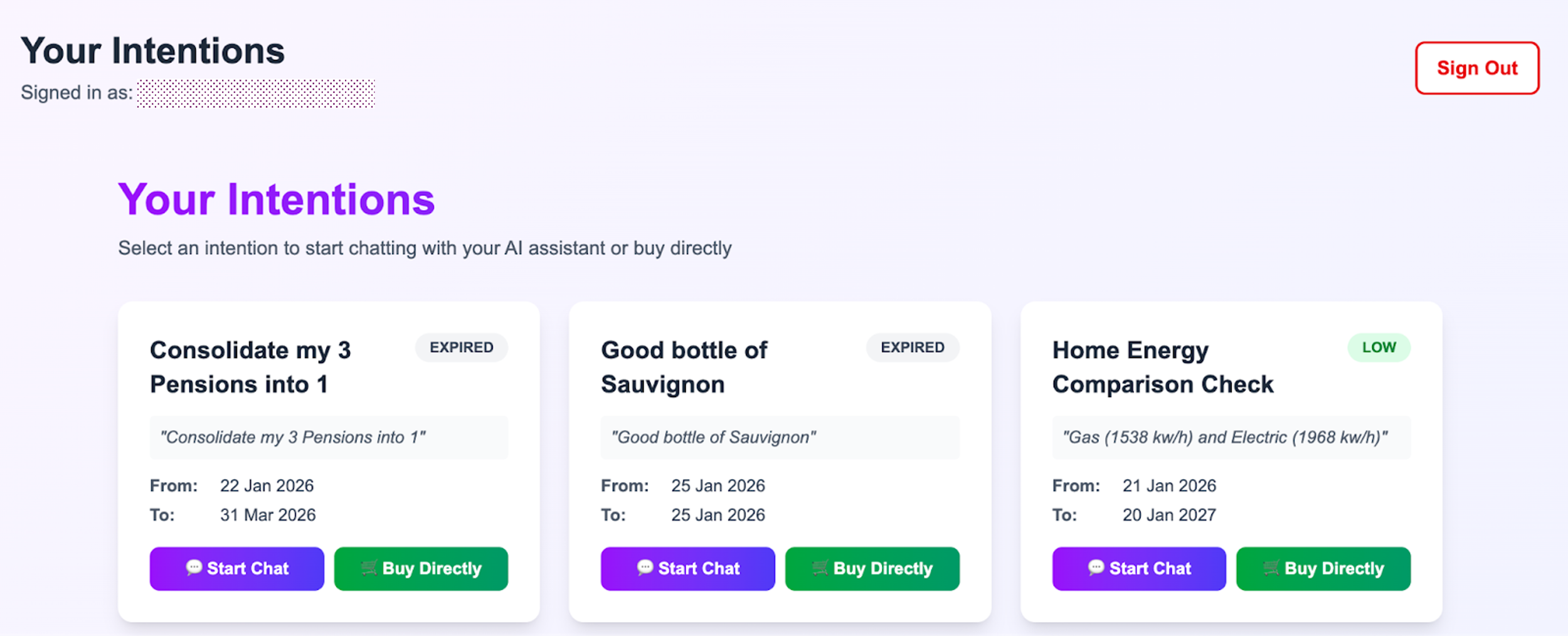
Mode 1: Direct Product Discovery - Your Intentions. Your Agent’s Mission.
How It Works
Direct mode embodies pure intention-based commerce. You store shopping intentions in your DataPal account:
“wireless headphones, noise-cancelling, under £150”
“kids’ t-shirt, age 5–6”
Your agent executes:
Retrieves your saved intentions
Pulls products from connected retailers
Scores each option against your requirements
Returns the best matches—with clear explanations
No browsing. No filtering. No manipulation.
Just execution.
This is the shift from CRM to Customer Empowerment - giving individuals the same operational capability companies have had for decades.
Intelligent Matching: Explainable AI, Not Guesswork
This is where DataPal diverges from pure LLM approaches. Matching is not a black box. It’s a structured, explainable system:
Requirement matching (price, size, colour, availability)
Semantic understanding (“hoodie” = “sweatshirt”)
Priority weighting (time-sensitive needs rise to the top)
The AI layer interprets and communicates. The matching logic evaluates and ranks.
Determinism handles decisions. AI handles understanding.
Why does this matter?
Explainability → you see why something was recommended
Consistency → results don’t drift or hallucinate
Trust → no hidden bias or manipulation
Efficiency → fast, repeatable outcomes
This is what fiduciary AI looks like in practice.
Mode 2: Conversational Commerce - Your Agent as Shopping Consultant
The Dialogue Experience
Not every intention is fully formed. Sometimes you’re exploring:
YOU: “I need a laptop”
AGENT: “What’s your primary use—work, gaming, or creative?”
YOU: “Work. Around £1000. Good battery.”
AGENT: “Here are 3 strong matches…”
In this mode, your agent helps you think, not just execute.
It clarifies requirements, surfaces trade-offs, and translates ambiguity into structured intent.
What Makes This Different?
Traditional chatbots guide you through a retailer’s funnel.
You adapt to the system.
DataPal flips this.
Your personal agent:
Starts with your needs
Builds your intention
Searches across retailers
Returns qualified matches
Retailers no longer control discovery. Your agent does.
This is not better personalisation.
This is delegation.
It reflects a deeper architectural shift as we've described before:
From navigating company interfaces → to agents acting on your behalf.
Receipt Capture
Where the Balance of Power Starts to Flip
The Problem: Receipts as Orphaned Data
Every purchase generates data.
But today:
It sits in your inbox
It’s hard to find
It’s disconnected from everything else
You generate the data — but you don’t control it.
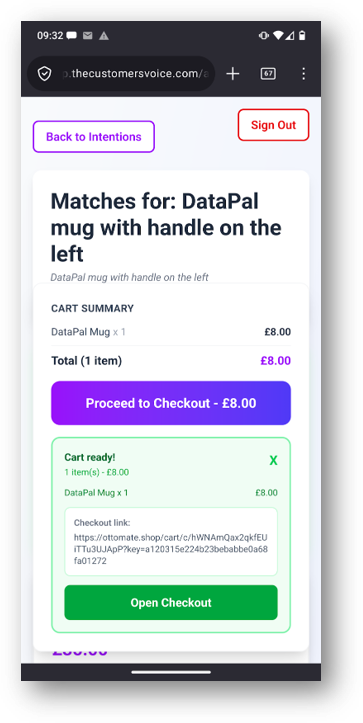
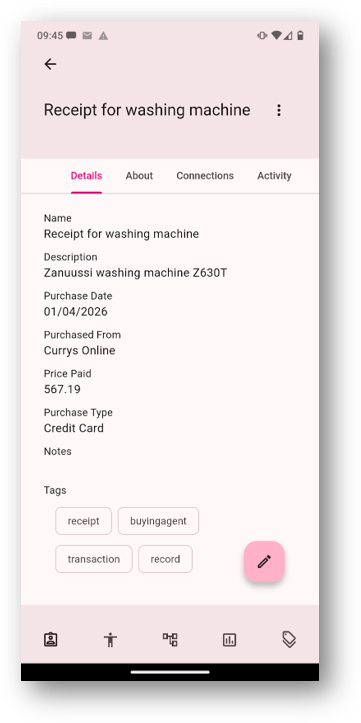
The Solution: Automatic Receipt Capture
DataPal closes the loop.
After checkout:
Payment confirmation is detected
Order data is structured
Receipt is posted to your DataPal vault
No forwarding emails.
No manual entry.
No separate apps.
The transaction comes back to you.
Why This Matters
This isn’t just convenience.
It’s a structural shift:
No reliance on retailer accounts
No data trapped in email systems
No duplication across tools
Portable transaction history becomes the default.
Your data becomes:
usable
exportable
actionable
For:
expenses
warranties
budgeting
tax
This is where customer infrastructure begins.
Why Two Modes? Agency Means Choice
“Why not just make everything conversational?”
Because natural isn’t always optimal.
Scenario 1: Recurring Purchase
You buy coffee every month.
Do you want a conversation?
No.
You want execution.
Direct mode wins
Scenario 2: New Category
You’re buying a laptop after 5 years.
Specs have changed. You’re unsure.
Conversational mode wins
The Real Insight
Customer agency isn’t one experience. It’s about giving us options.
Automation when you’re certain
Dialogue when you’re not
Direct mode = execution
Conversational mode = consultation
Together, they give individuals something they’ve never had:
Operational parity with organisations.
Privacy and Control - The Non-Negotiable Foundation
Everything described here depends on one principle:
Your data remains yours.
How DataPal Enforces This
Data Storage: Your intentions, preferences, and receipts live in your vault - not in company silos.
Access Control: Permissions are explicit, scoped, and revocable. And under your Terms.
Identity: Secure, portable identity replaces fragmented account systems.
Transparency: Every recommendation is explained. Nothing is hidden. Addressing the high cost for organisations in managing customer data.
This is not “privacy as compliance.”
This is control as infrastructure.
It reflects the shift from:
first-party data → to personally governed data (MyPD+)
passive users → to active agents with fiduciary support
The Bigger Picture: From Funnels to Qualification
For decades, companies have controlled:
discovery
targeting
conversion
Customers navigated.
"For decades, companies have had marketing automation, CRM, and sophisticated tech stacks while customers had spreadsheets and frustration. That power imbalance is ending."
That model is breaking.
When agents act on behalf of individuals:
There is no funnel to optimise
No retargeting loop to exploit
No interface to trap attention
Instead, a new model emerges: Qualification.
Companies must now ask: Do we meet the customer’s stated requirements?
Not: How do we persuade them?
Rebalancing Power
As we’ve said before:
For decades, companies had CRM, automation, and data infrastructure.
Customers had spreadsheets and frustration.
That imbalance is ending. The Standards exist.
This isn’t just better commerce.
This is the first time customers have infrastructure.
Why This Matters for Future Generations
Today’s children are growing up in a fully surveilled digital environment. As we explored in MyTerms is for our Children, today's children are growing up in the most surveilled environment in human history. Every action:
tracked
analysed
monetised
The shopping assistant offers a different path.
One where:
agents work for individuals
data creates value for its owner
systems serve people—not platforms
This isn’t just a product.
It’s a new baseline.
Lessons from Building: What actually matters
Transparency Beats Complexity: People trust what they understand.
Simple Often Wins: Not everything needs AI. Some things need clarity.
Identity Is Foundational: Without it, everything fragments.
Choice Enables Agency: One mode is a feature. Two modes are empowerment.
Conclusion: Customer Agency in Action
This isn’t a better chatbot.
It’s not a smarter recommendation engine.
It’s something more fundamental: Customers with their own agents, operating on their own data, fulfilling their own intentions.
Two modes. One principle: You are in control.
Not the retailer.
Not the platform.
Not the algorithm.
For decades, companies built systems to understand customers.
Now customers are building systems to represent themselves.
That changes everything.
The future isn’t better CRM.
It’s customers with their own agents.
The question is no longer whether this will happen.
The question is: are you ready?