

AI-Ready Waste Tracking with Trusted Data Relationships
Making environmental reporting verifiable, auditable and AI-ready.
Most people see the UK's new Digital Waste Tracking programme as an environmental initiative.
They're right.
But they're also missing the bigger story.
Behind the headlines about replacing paper waste transfer notes with digital reporting lies something far more significant. The Government is quietly changing who it designs digital services for.
For decades, public sector technology has largely focused on building websites for people. Citizens logged in, filled out forms and submitted information. Businesses employed administrators to enter the same information into multiple systems. Everyone became accustomed to re-keying data, uploading documents and navigating endless portals.
Digital Waste Tracking represents a different approach.
The primary user is no longer the person.
It's the software they already use.
When software becomes the customer
One of the most interesting aspects of the Digital Waste Tracking programme isn't the online portal.
It's the API.
Waste management software providers can integrate directly with the Government platform, allowing structured data to flow automatically from existing operational systems into the national tracking service.
The objective isn't to persuade thousands of organisations to change how they work.
It's to meet them where they already are.
Instead of asking businesses to duplicate information, the Government is creating digital infrastructure that allows trusted systems to exchange information automatically.
That is a profound shift.
Increasingly, the Government isn't building applications.
It's building platforms.
Today's software. Tomorrow's AI agents.
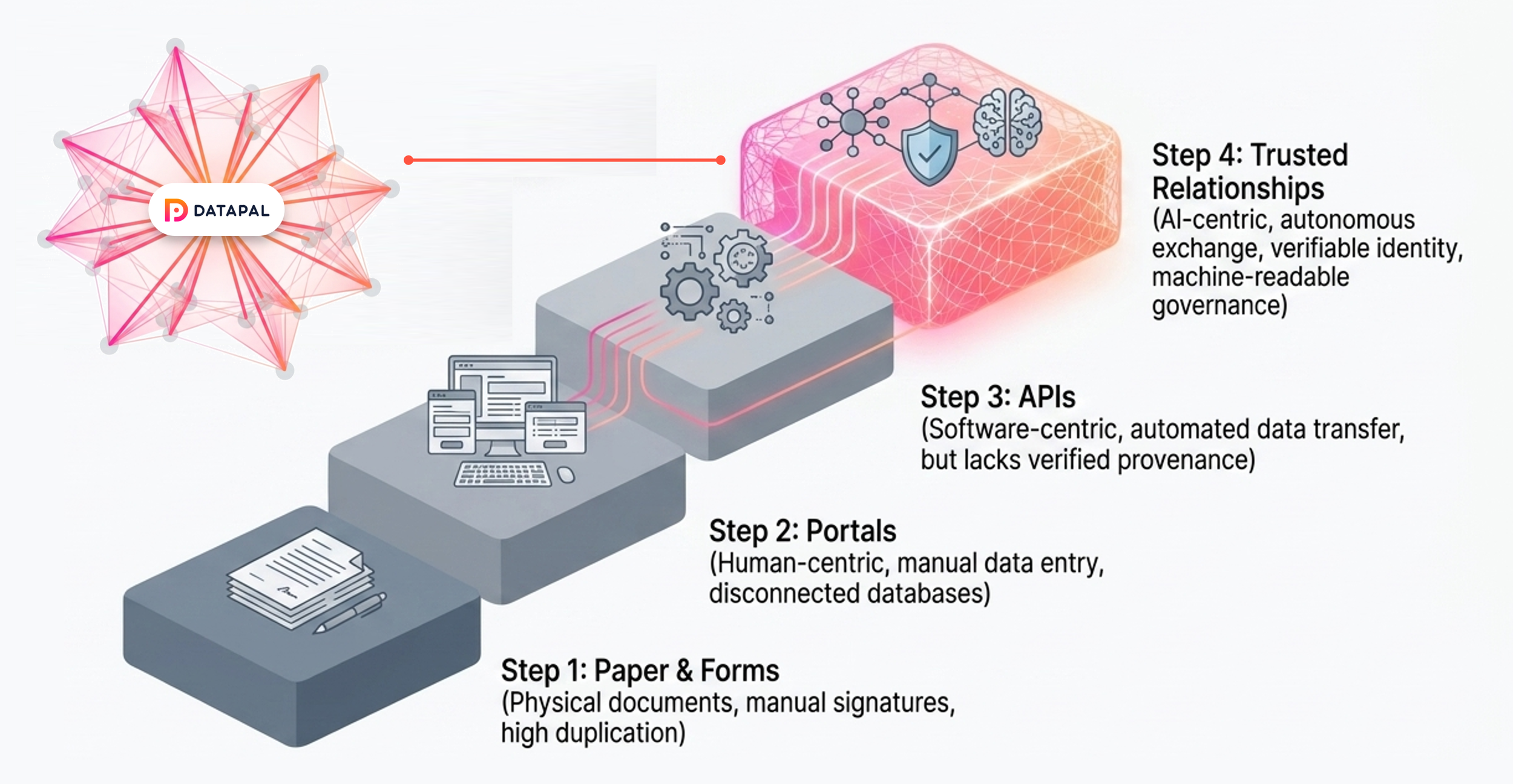
Today those integrations are largely software talking to software.
Tomorrow they will increasingly become AI Agents talking to AI Agents.
Imagine a waste producer's AI preparing a digital waste movement.
A carrier's AI confirms transport availability.
A recycling facility's AI validates permits, confirms treatment capacity and schedules delivery.
The regulator's systems automatically receive verified information.
Human intervention becomes the exception rather than the rule.
That future is much closer than many people realise.
But autonomous systems only work when they can trust the information they're exchanging.
That means they need much more than APIs.
They need trusted relationships.
From API-first to relationship-first
The technology industry often talks about being "API-first."
APIs are important.
But APIs simply allow systems to communicate.
They don't answer much more important questions.
Who requested the information?
Who is authorised to receive it?
For what purpose?
What exactly was shared?
Has permission been granted?
Can those permissions be withdrawn?
Can every interaction be independently verified later?
An API solves connectivity.
Trusted data relationships solve confidence.
That's a very different problem.
Trust becomes infrastructure
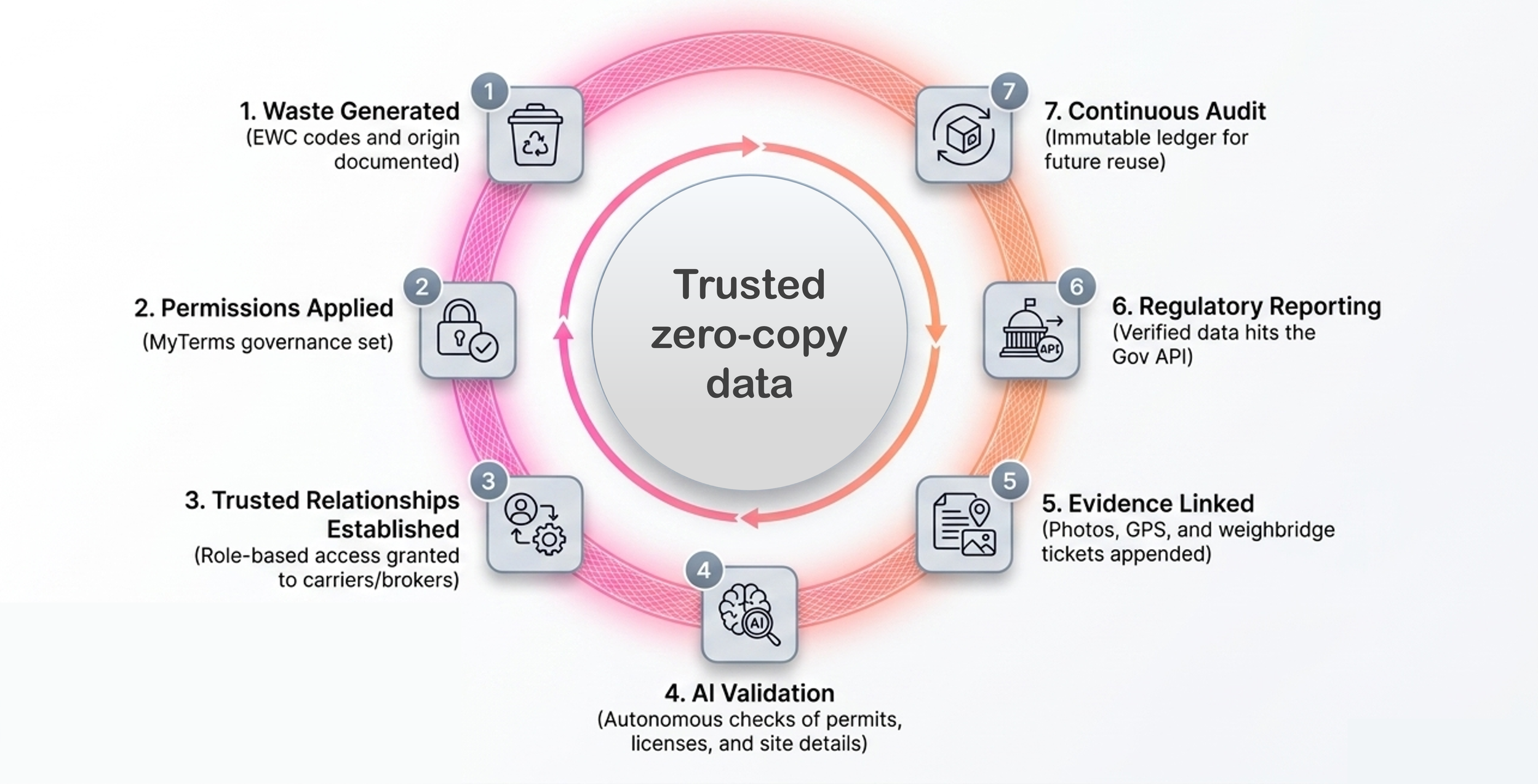
Every waste movement involves multiple independent organisations.
Waste producers.
Carriers.
Brokers.
Receiving facilities.
Recyclers.
Regulators.
Each organisation needs access to different information at different stages of the process.
Success depends on every participant trusting the quality, provenance and integrity of the information they receive.
This isn't unique to waste.
The same challenge exists across healthcare, financial services, advertising, digital identity, Smart Data, Digital Product Passports, ESG reporting and countless other industries.
The common requirement isn't another application.
It's a trusted digital infrastructure.
Ecosystems succeed. Applications don't.
Perhaps the most important lesson from Digital Waste Tracking is that success won't be determined by the Government platform itself.
It will be determined by whether the surrounding ecosystem adopts it.
Software vendors must integrate.
Businesses must trust it.
Data standards must remain consistent.
Commercial models must work.
Onboarding must be simple.
Everyone involved must benefit.
We've seen exactly the same pattern with Open Banking.
Smart Data.
Digital Identity.
And now AI.
Technology doesn't succeed because one application is well designed.
It succeeds because an ecosystem chooses to participate.
Better data creates better intelligence
Digital forms are not the goal.
Trusted data is.
Poor-quality digital data simply replaces paper with electronic paperwork.
Trusted, structured and interoperable data creates something entirely different.
It enables automation.
Analytics.
Policy.
Transparency.
Resource optimisation.
AI.
Once information becomes reliable enough to trust, organisations stop merely recording events.
They begin learning from them.
Compliance platforms become intelligence platforms.
The missing layer
This is where we believe DataPal has an important role to play.
Digital Waste Tracking defines what information should be reported.
DataPal helps govern how trusted information is exchanged between the organisations responsible for creating it.
Through permissioned data sharing, verifiable identities, machine-readable agreements using MyTerms, transparent audit trails and trusted data relationships, organisations can exchange information with confidence whilst maintaining clear governance over who can access it, why it was shared and how it may be used.
Importantly, this approach avoids unnecessary duplication.
Rather than creating multiple copies of the same information, organisations can securely share permissioned access to trusted data, preserving provenance whilst reducing administrative overhead.
The result isn't simply better compliance.
It's infrastructure that is ready for AI.
Looking beyond waste
Digital Waste Tracking is unlikely to be the last national platform built this way.
The same principles are already emerging across environmental reporting, Digital Product Passports, carbon accounting, circular economy initiatives, supply chains and Smart Data programmes.
The pattern is becoming increasingly clear.
Governments are no longer simply building systems for people.
They're building trusted infrastructure for software.
Soon, they'll be building trusted infrastructure for AI Agents.
In that world, APIs alone won't be enough.
Success will depend on trusted data relationships built around verifiable identities, clear permissions, transparent agreements, provenance and accountability.
Waste tracking may simply be one of the first examples.
It certainly won't be the last.
As AI increasingly acts on behalf of people and organisations, the question is no longer whether systems can exchange data.
The question is whether they can trust it.
That may prove to be the defining challenge of the next generation of digital infrastructure.
Footnote and a Call to Action
If you are:
Designing smart data schemes
Regulating data exchange
Building platforms or AI systems
Then the question is NOT:
“How do we implement another scheme?”
But:
“Are we building towards a network or away from one?”
We’re currently partnering with a small number of Organisations and Partners to explore these ideas through targeted proofs of concept. If you’re thinking seriously about the future of Smart Data, AI, and individual data control, we’d be interested in hearing from you.