

My Advertising Agency
What if the advertising agency that knew you best was the one that worked for you?
For decades, advertising has been built on a remarkably difficult challenge.
How do you discover what millions of people might want to buy, often before they know it themselves?
The industry's answer has been to observe, infer and predict. Every search, click, purchase, location, page view and video watched has become another signal in an increasingly sophisticated attempt to understand future demand. An extraordinary technology ecosystem has emerged around that challenge, underpinning an industry now worth more than $1.7 trillion globally.
It is an astonishing engineering achievement.
Yet despite decades of innovation, one uncomfortable question remains.
What if we have been looking for demand in entirely the wrong place?
From inference to intention
In our previous article, What if my Estate Agent was an AI Agent?, we explored how Agentic AI is likely to have its greatest impact in industries where "agency" already exists. Estate agents represent buyers and sellers. AI agents simply have the potential to undertake much of that work better, faster and more intelligently.
Advertising may be the biggest agency-enabled industry of them all.
But perhaps we've misunderstood who the agency should be working for.
What if, instead of organisations trying to build increasingly accurate profiles of us, our own AI agents became our advertising agencies?
Not agencies representing brands.
Agencies representing individuals.
That single shift could fundamentally change how digital advertising operates.
The Personal Agency
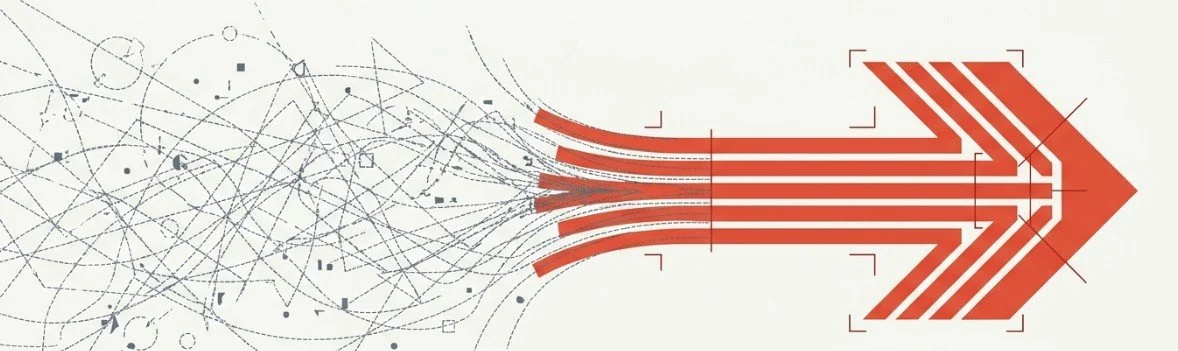
Moving from inferred surveillance to declared intent in a $1.7 trillion economy
Advertising isn't the problem
Advertising itself is not the enemy.
Good advertising helps people discover products, services and experiences that genuinely improve their lives. It introduces innovation, supports competition and funds much of the digital economy we enjoy today.
The problem is not advertising.
The problem is inefficiency.
For every advertisement that reaches someone at exactly the right moment, thousands do not.
Anyone who has worked in marketing knows the challenge. John Wanamaker famously observed:
"Half the money I spend on advertising is wasted; the trouble is I don't know which half."
Over a century later we have vastly more data, incomparably more computing power and AI capable of generating millions of personalised adverts in seconds.
Yet the fundamental challenge remains remarkably similar.
Most advertising still reaches people who are not currently interested.
Even worse, people who have already bought something are often pursued by adverts for weeks afterwards.
The technology has become dramatically more sophisticated.
The underlying model has not.
Guessing what people want
Today's advertising ecosystem relies on inference.
Thousands of organisations each build their own partial understanding of an individual.
Retailers know what we buy from them.
Banks understand our financial behaviour.
Travel companies know where we travel.
Streaming services know what we watch.
Social platforms observe what captures our attention.
Data brokers attempt to connect those fragments together.
The result is an extraordinary collection of identity graphs, audience segments and behavioural models designed to answer one question:
What might this person want next?
The difficulty is obvious.
No organisation ever sees the complete picture.
Every profile is incomplete.
Every prediction carries uncertainty.
Sometimes they are spectacularly wrong.
A father regularly buying cosmetics for his teenage daughter suddenly becomes an ideal candidate for beauty products.
Someone researching holidays for a friend appears ready to book a trip themselves.
A single purchase becomes evidence of a long-term interest.
The system is intelligent.
But it is still guessing.
An Individual's Market Journey
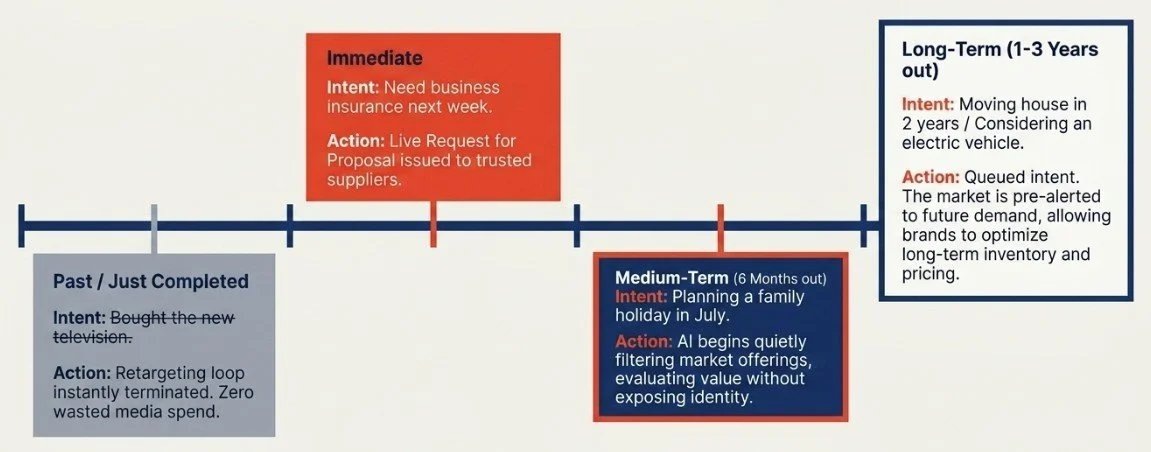
Instead of chasing behavioural clues, the ecosystem responds to verified, time-bound intent, declared directly by an individual’s AI.
The one organisation that knows the answer
Now imagine a different starting point.
Imagine an AI agent that works exclusively for you.
It understands your calendar.
It knows your finances.
It understands your family.
It can see your travel plans.
It knows your subscriptions.
It knows when your insurance renews.
It knows you're moving house.
It knows your daughter is about to start university.
It knows you're replacing your car.
It knows your dog is due vaccinations.
It even knows what you've already bought.
Who could possibly build a more accurate picture of your future needs?
Nobody.
Not because the AI is cleverer.
Because it represents the only person who has access to the complete context.
The future of advertising may not lie in better prediction.
It may lie in simply asking the person.
From surveillance to declaration
This is where Agentic AI becomes genuinely transformative.
Today's advertising asks:
"What can we discover about this individual?"
Tomorrow's advertising may ask something entirely different:
"What does this individual want us to know?"
That distinction matters.
Instead of organisations inferring buying intent from fragmented observations, individuals could choose to declare their intentions directly through AI agents acting on their behalf.
"I'll be looking for a new mortgage in six months."
"I'm planning a family holiday."
"I need business insurance."
"I'm considering an electric vehicle."
"I've already bought the television."
Suddenly the advertising ecosystem changes from chasing behavioural clues to responding to explicit intent.
Instead of guessing.
It listens.
Your AI becomes your advertising agency
This is perhaps the biggest conceptual shift.
Today, advertising agencies largely represent brands.
Tomorrow, every individual could have their own advertising agency.
An AI agent acting on a fiduciary basis could continuously maintain an accurate understanding of the person's circumstances, preferences and intentions.
It could decide:
what information should be shared
who should receive it
for what purpose
for how long
under what conditions
and record exactly what happened.
Rather than following people around the internet trying to infer demand, organisations would increasingly respond to verified demand shared with permission.
Advertising becomes less about interruption.
More about introduction.
Negotiating the Terms of Demand
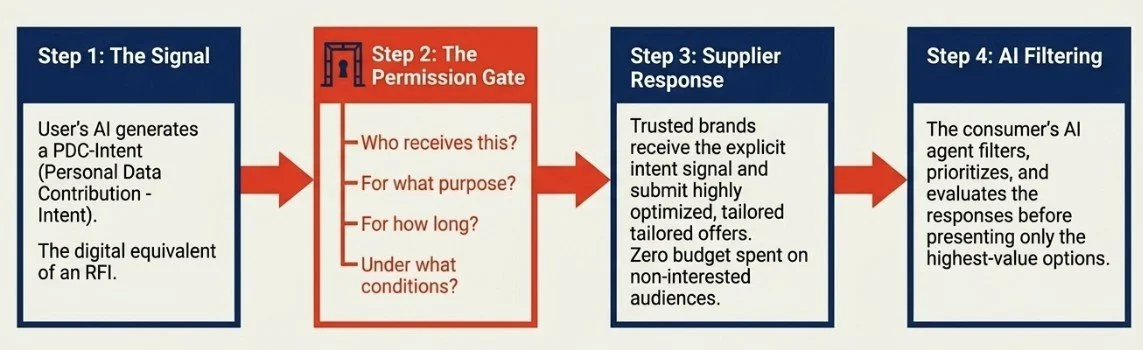
The missing ingredient hasn't been technology; it has been governance. Emerging standards like MyTerms (IEE 7012) transform real-time bidding, into real-time, permissioned response.
The technology already exists
Interestingly, none of this requires a technological breakthrough.
Much of the infrastructure already exists.
The advertising industry has developed sophisticated standards for describing audiences, including the IAB's Curated Audiences taxonomy covering demographics, interests and intent.
AI can already maintain these profiles dynamically.
Open Banking, loyalty data, calendars, purchase histories and other trusted data sources can contribute to a far richer understanding of future requirements than any single organisation could ever assemble.
The missing ingredient has not been technology.
It has been governance.
Who owns the profile?
Who controls access?
Who decides what gets shared?
Enter permissioned intent
This is where emerging standards become particularly interesting.
The recently published IEEE 7012 standard, better known as MyTerms, introduces machine-readable agreements through which individuals and organisations can negotiate the terms under which information is shared.
One agreement type, Personal Data Contributions – Intent (PDC-Intent), is particularly relevant.
Rather than organisations attempting to infer purchasing intent, individuals can explicitly state that they are looking for information, products or offers relating to a particular need.
Think of it as the digital equivalent of issuing a Request for Information or Request for Proposal.
The individual, or more likely their AI agent, decides who receives the request.
Suppliers respond.
Responses can be filtered, prioritised and evaluated by the individual's AI before they are ever seen.
The individual remains in control throughout.
The relationship becomes transparent, auditable and revocable.
Better for individuals. Better for brands.
At first glance, some might wonder why anyone would volunteer information about their buying intentions.
The answer is simple.
Because alignment creates value.
Today's model often creates friction.
People receive irrelevant advertising.
Brands waste enormous budgets.
Platforms compete to capture ever more behavioural data.
Everyone expends effort compensating for imperfect information.
Permissioned intent changes the economics.
Individuals receive genuinely relevant offers.
Brands spend less reaching people who are not interested.
Advertising agencies optimise responses rather than predictions.
AI agents reduce search costs for everyone involved.
The result is a market that is both more efficient and more respectful.
Following the incentives
Markets change when incentives align.
Technology alone is never enough.
Fortunately, there are many reasons why this model could emerge.
Individuals save time and receive better recommendations.
Brands dramatically reduce wasted media spend.
Publishers continue monetising valuable audiences.
Advertising agencies develop new services around AI-driven demand management.
Data intermediaries create trusted infrastructure for permissioned relationships.
Value begins flowing towards the people whose data creates it rather than disappearing into increasingly complex chains of intermediaries.
Trust becomes a competitive advantage.
Not a compliance obligation.
So how does this scale?
There are several possibilities.
One is to build a consumer movement.
Over time, individuals increasingly adopt personal AI agents that represent their interests across digital markets.
Another is to build an agent movement.
Brands deploy AI agents.
Individuals deploy AI agents.
Markets become conversations between trusted digital representatives acting on behalf of both sides.
Perhaps the most likely outcome is simpler still.
The advertising industry gradually repurposes much of the infrastructure it already has.
Real-time bidding becomes real-time response.
Audience targeting becomes permissioned intent.
Identity graphs become customer-owned relationship graphs.
The technology evolves.
The incentives improve.
The market adapts.
A different future for advertising
For more than thirty years, digital advertising has invested extraordinary effort trying to infer what people want.
Agentic AI offers something fundamentally different.
People can simply tell us.
Not constantly.
Not publicly.
Not to everyone.
Only when they choose.
Only under agreed terms.
Only with trusted organisations.
Perhaps the future of advertising is not one where AI becomes even better at predicting us.
Perhaps it is one where our own AI becomes our advertising agency.
The question is no longer whether the technology exists.
The more interesting question is this:
Which brands, agencies and platforms will be the first to embrace an advertising ecosystem built on trusted, permissioned relationships rather than surveillance and guesswork?
Footnote and a Call to Action
If you are:
Designing smart data schemes
Regulating data exchange
Building platforms or AI systems
Then the question is NOT:
“How do we implement another scheme?”
But:
“Are we building towards a network or away from one?”
We’re currently partnering with a small number of Organisations and Partners to explore these ideas through targeted proofs of concept. If you’re thinking seriously about the future of Smart Data, AI, and individual data control, we’d be interested in hearing from you.