

Beyond Consent: Why Trust Management Platforms Are Emerging
Why the future of digital trust is really about trusted personal digital relationships
For nearly a decade, the Consent Management Platform (CMP) has been one of the defining technologies of the privacy landscape.
Driven by ePrivacy, PECR (UK) and GDPR and similar legislation around the world, organisations adopted cookie banners and consent tools to demonstrate compliance and give individuals greater control over how their personal information is collected and processed.
An entire global industry emerged around answering a single question:
"May I collect and use your data?"
It was an important step forward.
But it was also a solution designed for an internet where humans interacted directly with websites.
That internet is changing.
Today, AI agents are beginning to represent individuals. Organisations are deploying intelligent services that make decisions autonomously. Increasingly, software is talking directly to software across organisational boundaries.
In that world, asking someone to manually click "Accept All" or ‘Essential Only’ every time they visit a website or mobile application no longer feels like the long-term answer. Nor even close.
The Consent Management Platform solved yesterday's problem.
Tomorrow's internet needs something broader.
From consent to trust
The next generation of digital relationships will not be built solely on consent.
They will be built on trust.
Consent answers one important question:
"Do I have permission for this thing I want to do?"
But the age of agentic AI requires us to answer many more.
Who (what) are you?
Are you acting on behalf of an individual? (Who are you acting for?)
Can your identity be verified?
What permissions and capabilities have been delegated?
What data do you have access to?
Can I trust the information you've provided?
Are your actions transparent and auditable?
What are your guardrails?
Who is accountable and liable if something goes wrong?
These are no longer simply privacy or data protection questions.
They are trust questions.
We believe this represents the natural evolution of today's Consent Management Platform into tomorrow's Trust Management Platform.
Not because consent disappears.
But because consent becomes just one capability within a much broader permissions framework for establishing trusted digital interactions.
Regulation is already pointing in this direction
This isn't simply a technology prediction.
The regulatory landscape is already moving in the same direction.
The proposed EU Digital Omnibus introduces Article 88b, recognising the importance of machine-readable privacy signals that allow individuals to communicate their privacy preferences automatically rather than repeatedly interacting with cookie banners.
Globally, Global Privacy Control (GPC) has demonstrated how privacy preferences can be expressed as standardised digital signals that websites and online services can recognise automatically.
At the same time, MyTerms (IEEE P7012) introduces a globally recognised standard for expressing an individual's privacy preferences as portable, machine-readable terms.
Taken together, these developments represent something much more significant than the gradual improvement of cookie banners.
They point towards an internet where privacy preferences and permissions become portable.
Instead of every website asking us to accept their terms, individuals increasingly arrive carrying their own.
The relationship changes from:
Organisation → Individual
"Please accept our terms."
to
Individual ↔ Organisation
"Here are my proposed terms."
This is no longer a one-sided interaction.
It is the beginning of a trusted relationship between equals.
Trust starts with privacy but it doesn't end there
Privacy is simply the first signal.
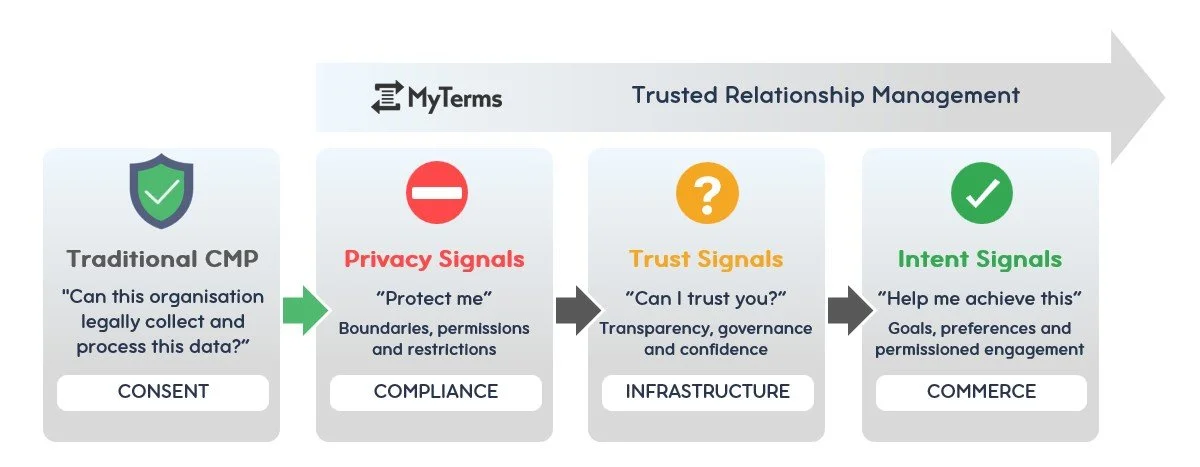
At DataPal we increasingly think about digital relationships as being built upon three complementary layers of machine-readable signals.
🔴 Privacy Signals
Protect me.
Privacy Signals define an individual's boundaries.
They express what information may be used, under what conditions and for what purposes.
This is where MyTerms, Global Privacy Control and Article 88b begin.
They replace repetitive consent journeys with portable, machine-readable preferences that travel with the individual.
🟠 Trust Signals
Can I trust you?
Once privacy has been established, a second question naturally follows.
Can I trust the organisation, service or AI agent I'm interacting with?
Trust Signals provide the evidence needed to answer that question.
Identity.
Orientation - who does it work for? If on a fiduciary basis then to whom?
Governance.
Provenance.
Certification.
Transparency.
Auditability.
Accountability.
These signals become increasingly important as AI systems begin acting autonomously on behalf of both individuals and organisations.
🟢 Intent Signals
Help me achieve my goals.
The final layer moves beyond protection.
Instead of simply defining what should not happen, Intent Signals describe what an individual actually wants to achieve. Their context…
Goals.
Preferences.
Delegated authority.
Accessibility requirements.
Buying intentions.
Communication preferences.
Life events.
Trusted AI services can then act proactively in support of those objectives, always within the permissions established by the individual.
Together these three layers move us beyond permission management towards relationship management.
Why DataPal was built differently
This is where DataPal takes a fundamentally different approach.
DataPal was built on a simple principle.
Digital relationships should work more like trusted human relationships.
The strongest relationships are built on mutual understanding, clear expectations and accountability.
They respect boundaries.
They are transparent.
They create confidence for everyone involved.
DataPal applies those same principles to the exchange of information between individuals, organisations and increasingly AI-powered services.
At the heart of this is DataPal's fiduciary model.
Rather than simply helping organisations obtain consent, DataPal enables data sharing on a fiduciary basis acting in accordance with an individual's interests and expressed instructions.
This creates trusted data relationships built upon:
Verifiable permissions.
Transparent agreements.
Accountable AI interactions.
Machine-readable policies.
Auditable evidence.
Clear governance.
As a result, individuals, organisations and AI-powered services can safely exchange information with permissions, proof and accountability built in from the outset.
The emergence of the Trust Management Platform
Viewed through this lens, the future of today's Consent Management Platform becomes much clearer.
Tomorrow's Trust Management Platform is no longer simply a place where consent records are stored.
It becomes the platform through which trusted digital relationships are established.
A future Trust Management Platform could manage:
Privacy Signals through MyTerms and other machine-readable privacy standards.
Trust Signals through verifiable identity, governance, provenance and audit.
Intent Signals through goals, preferences and delegated permissions.
Consent doesn't disappear.
It simply becomes a chapter in a much larger story.
Beyond Trust Management
We believe the evolution doesn't stop there.
The ultimate objective isn't to manage consent.
Nor is it simply to manage trust.
The real objective is to manage trusted relationships.
Relationships between customers and the organisations they engage with digitally.
Patients and healthcare providers.
Citizens and government.
Employees and employers
Partners across supply chains.
And increasingly, relationships between people and AI agents acting faithfully on their behalf.
This points towards an even broader discipline that we believe will emerge over the coming decade:
Trusted Relationship Management (TRM).
Just as Customer Relationship Management transformed how organisations managed customer interactions, Trusted Relationship Management has the potential to transform how individuals, organisations and AI systems establish, maintain and evolve trusted digital relationships.
Trust Management Platforms become the operational layer.
Trusted Relationship Management becomes the strategic outcome.
DataPal enables that future
DataPal is not building another Consent Management Platform.
Nor are we positioning ourselves as a Trust Management Platform.
Instead, DataPal is building the trust infrastructure that enables and orchestrates the next generation of Trust Management Platforms and the broader world of Trusted Relationship Management.
Our work with a large and sophisticated Consent Management Platform providers demonstrates how that journey begins today.
The first step is the adoption of machine-readable privacy terms through MyTerms.
The next is the introduction of verifiable Trust Signals.
Then come Intent Signals that enable AI-powered services to act safely and proactively on behalf of individuals.
Each stage builds upon the last.
Privacy establishes confidence.
Trust enables relationships.
Intent creates shared value.
A new chapter for the internet
Every major evolution of the internet has required new infrastructure.
Search required search engines.
Digital commerce required payment networks.
Cloud computing required identity platforms.
The age of AI requires something different again.
It requires infrastructure capable of establishing trusted relationships between individuals, organisations and autonomous digital services.
Consent Management Platforms have served the web well.
Trust Management Platforms will serve the agentic internet.
But ultimately, the destination is even bigger.
Not better consent.
Not simply more trust.
Trusted digital relationships.
We believe that is where the internet is heading.
And we believe the infrastructure to support it is already beginning to emerge.
Footnote and a Call to Action
If you are:
Designing smart data schemes
Regulating data exchange
Building platforms or AI systems
Then the question is NOT:
“How do we implement another scheme?”
But:
“Are we building towards a network or away from one?”
We’re currently partnering with a small number of Organisations and Partners to explore these ideas through targeted proofs of concept. If you’re thinking seriously about the future of Smart Data, AI, and individual data control, we’d be interested in hearing from you.